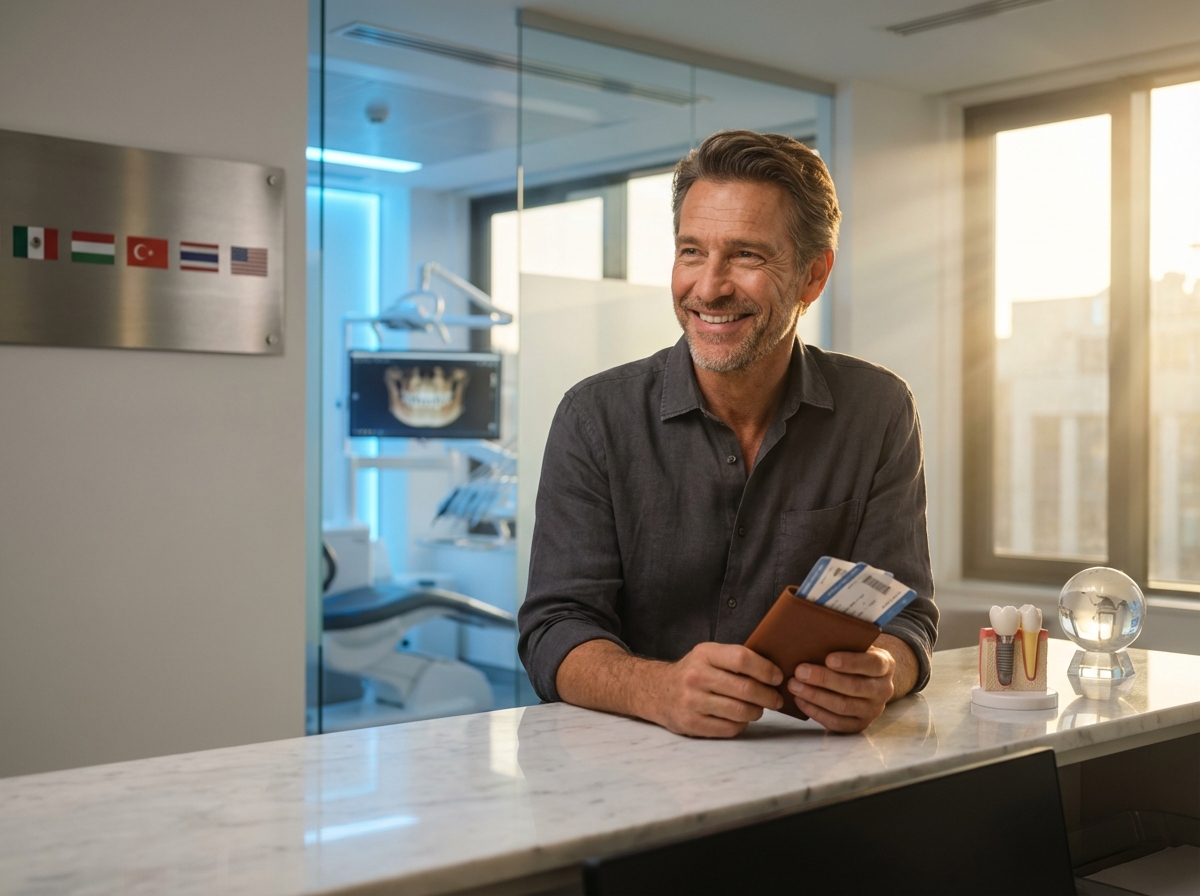
Planning All-on-4 treatment abroad can save thousands while giving access to high-quality care. This guide compares global 2025 price ranges, explains the key cost drivers, offers a clinic and travel checklist, and highlights safety and follow-up best practices. Use these insights from Dental Travel Compass USA to plan an informed, cost-effective, and safe dental trip.
Understanding All-on-4 and why patients travel abroad
The All-on-4 protocol represents a significant shift in how dental professionals treat total tooth loss. This technique uses four dental implants to support a full arch of permanent teeth. Two implants are placed vertically in the front of the jaw, while the other two are placed at an angle in the back. This specific orientation allows the surgeon to engage the densest part of the jawbone, often removing the requirement for bone grafting. Many patients who were told they lacked the bone density for traditional implants find they are good candidates for this method. The process typically involves immediate loading, meaning a temporary bridge is attached to the implants within a few days of surgery. Patients do not have to wait months with a removable denture while the implants heal.
Success rates for this protocol are high, often exceeding 95 percent. However, biological healing varies by person. Smoking is the most significant risk factor for failure; it drastically reduces the ability of the bone to bond with the titanium. Patients are strongly advised to cease smoking at least two weeks prior to surgery and continue to abstain for at least three months post-surgery to ensure proper osseointegration.
A typical treatment starts with a detailed consultation and 3D imaging. Surgeons use CBCT scans to map out the bone structure and avoid nerves or sinus cavities. The components of the system include the titanium implant fixtures and the abutments that connect the implants to the teeth. The teeth themselves are part of a prosthesis. During the first phase, this is usually a high-quality acrylic bridge. Later, it is replaced by a final version made of more durable materials. Candidates for this procedure include people who are currently wearing dentures or those with failing teeth due to decay or gum disease. It is a faster path to rehabilitation compared to older methods that required six or eight implants and multiple surgeries.
The clinical advantages of this approach are clear. Using fewer implants reduces the total surgical time and lowers the risk of complications during the healing phase. Because the back implants are tilted, they provide a stable foundation even in thin bone. This bone-sparing technique is a major benefit for older patients. The timeline is also much shorter than traditional methods. A patient can often go from failing teeth to a fixed bridge in less than a week. The final prosthesis is usually fitted three to six months later, allowing the bone to fully fuse with the titanium.
Many patients in the United States look at international options because of high domestic costs. In 2025, a single arch of All-on-4 implants in a U.S. clinic often costs between $20,000 and $35,000. You can find a detailed breakdown of these figures in this guide on How Much Do All-On-4 Dental Implants Cost in 2025?. Traveling to countries like Mexico, Turkey, or Hungary can result in savings of 50 to 70 percent. These clinics often have access to the same premium brands like Nobel Biocare or Straumann. Some international centers specialize specifically in dental tourism, offering shorter waiting times and bundled packages. These bundles might include the surgery, hotel stays, and transportation from the airport, making the logistics easier for a patient traveling from a different country.
However, dental tourism is not without its challenges. Continuity of care is a primary concern. If a complication arises after you return home, your local dentist might be unwilling to work on implants placed by someone else, leading to extra costs for emergency visits. Language barriers can also complicate the process; it is vital to ensure the surgeon and the staff speak clear English to avoid misunderstandings about the procedure or the warranty. Travel itself carries risks, as long flights shortly after surgery can increase the chance of blood clots or swelling. Furthermore, if something goes wrong, regulations in a foreign country may not offer the same protections as the American legal system.
A patient should use a strict decision framework when weighing these options. Start by calculating the total landed cost. This includes the procedure price plus flights, hotels, and meals. You should also set aside a contingency fund of at least 20 percent for unexpected needs. Compare this total to the cost of a local specialist. If the savings are minimal, the convenience of staying home usually wins. Quality must be the priority. Ask the clinic for the specific brand and serial numbers of the implants they use. Research the credentials of the surgeon, looking for those who have completed residencies in oral surgery or prosthodontics. A successful outcome depends on the skill of the doctor and the quality of the materials. Balancing these factors is the only way to ensure that affordable care is also safe care.
Key factors that determine the final price
Understanding the price of All-on-4 dental implants requires looking past the single number on a clinic website. The total cost is a puzzle made of several expensive pieces. Each choice you make regarding materials and technology shifts the final balance. In the United States, prices for a single arch often sit between $20,000 and $35,000 in 2025. You can find more details on these domestic averages in this guide on how much All-on-4 dental implants cost in 2025. When you look abroad, the components remain the same, but the labor and overhead costs change the math.
Implant Brands and Component Costs
The actual titanium or zirconia screws that go into your jaw are a major cost driver. Premium brands like Nobel Biocare, Straumann, and Zimmer Biomet are the industry leaders. These companies have decades of research backing their designs. In 2025, the wholesale cost for a clinic to buy one premium implant fixture ranges from $150 to $800. For an All-on-4 procedure, you need four of these per arch. Beyond the implants, you must pay for abutments. These are the connectors that join the implant to the teeth. Angled or multi-unit abutments can cost the clinic up to $350 each. Some budget clinics use generic or lesser-known brands to keep quotes low. While these might work, finding replacement parts ten years from now can be difficult if the manufacturer goes out of business.
The Type of Prosthesis and Longevity
The teeth themselves represent a huge portion of your bill and dictate the longevity of the restoration. You generally have three choices. An acrylic hybrid is the most affordable, using denture teeth on a titanium frame. While esthetic, acrylic bridges typically last 5 to 7 years before needing repair or replacement due to wear and staining. A step up is a titanium bar with acrylic, which offers better reinforcement. The gold standard in 2025 is monolithic zirconia. This material is incredibly strong and looks very natural. However, it is expensive to produce, requiring high-end milling machines and skilled lab technicians. A zirconia arch can cost a clinic between $3,500 and $10,000 just to manufacture. This is why a “basic” All-on-4 quote might suddenly jump by $5,000 if you choose the best materials.
Digital Planning and Surgical Fees
Modern implant surgery is no longer done by sight alone. Clinics now use CBCT scans to create a 3D map of your jaw. This allows the surgeon to use digital planning software to place implants where the bone is densest. Many top-tier clinics also use guided surgery. They 3D-print a surgical template that fits over your gums to guide the drill. These digital steps add about 5 to 10 percent to the total fee. You also pay for the surgeon’s expertise. A board-certified oral surgeon or a prosthodontist will charge 15 to 40 percent more than a general dentist. This premium covers their specialized training and their ability to handle complex surgical complications.
Anesthesia and Ancillary Costs
How you choose to sleep through the procedure affects the price. Local anesthesia is usually included in the base price. If you want IV sedation or general anesthesia, expect to pay an extra $800 to $3,000. This often requires a separate anesthesiologist to be present. You also need to account for pre-operative diagnostics. Blood tests, EKG clearances, and initial consultations can add several hundred dollars. If you have been missing teeth for a long time, your jawbone might have thinned. Bone grafting or sinus lifts are often necessary to create a stable foundation. A sinus lift can add up to $4,000 to your bill depending on the complexity.
The Typical Cost Breakdown
To help you visualize where your money goes, consider these approximate percentage ranges for a standard All-on-4 case:
- Implant components and hardware: 25 to 40 percent
- Prosthesis and laboratory fees: 30 to 45 percent
- Clinician and surgical fees: 15 to 30 percent
- Ancillary costs like imaging and anesthesia: 5 to 10 percent
These ratios stay fairly consistent even when the total price drops in countries like Mexico or Turkey. The main difference is that the clinician fees and lab labor are significantly lower in those regions.
Economic and Seasonal Variables
External factors can change your out-of-pocket cost overnight. Exchange rates are the most volatile. If the U.S. dollar drops against the local currency of your destination, your treatment becomes more expensive. Seasonal pricing also plays a role. Many dental tourism hubs see a surge in patients during the winter. Hotels and clinics may raise prices or offer fewer discounts during these peak months. Conversely, you might find promotional packages during the off-season that include free hotel stays or airport transfers. Always check if the quote includes local taxes or import duties on the implants. Some countries have a Value Added Tax (VAT) that can add 20 percent to the bill if it is not explicitly included in the initial estimate. Finally, look at the warranty. A clinic that offers a robust guarantee on both the parts and the labor provides more value than a “cheap” clinic with no post-op support. For a broader look at how these prices compare to the American market, you can check this 2025-2026 guide on dental implant costs in the USA.
Global price comparison 2025 with regional notes
Comparing global prices for All-on-4 dental implants in 2025 requires looking at the total landed cost. This includes the procedure, travel, and recovery time. While the previous chapter detailed how components and lab fees build the price, this section focuses on where those numbers land across different markets. The following table provides a snapshot of the current landscape for a single arch restoration.
| Country | Typical 2025 Price Range (USD) | Midpoint Price |
|---|---|---|
| United States | $20,000 to $35,000 | $27,500 |
| Mexico | $5,000 to $12,000 | $8,500 |
| Turkey | $3,500 to $9,000 | $6,250 |
| Thailand | $4,500 to $10,000 | $7,250 |
| Hungary | $6,500 to $14,000 | $10,250 |
| Costa Rica | $7,000 to $15,000 | $11,000 |
| Colombia | $6,000 to $14,000 | $10,000 |
| Poland | $6,000 to $12,000 | $9,000 |
| Spain | $7,000 to $16,000 | $11,500 |
| India | $3,000 to $8,000 | $5,500 |
United States
Typical 2025 Price Range
The cost for a single arch typically ranges from $20,000 to $35,000. High-end practices in urban centers often charge $40,000 or more for premium materials. You can find more details in this guide on Dental Implant Cost in the USA: 2025–2026 Guide?
What is Included
The price usually covers the surgical placement of four implants, a temporary acrylic prosthesis, and basic 3D imaging. Some clinics include the final prosthesis in the initial quote, but others bill it separately.
Common Exclusions
Extractions, bone grafting, and IV sedation are frequently extra. Expect to pay $800 to $3,000 for anesthesia services.
Clinic Credentials
Look for board-certified oral and maxillofacial surgeons or prosthodontists. Most reputable clinics maintain American Dental Association membership.
Travel Note
Domestic travel is simple. No language barriers exist for English speakers.
Mexico
Typical 2025 Price Range
$5,000 to $12,000 per arch.
What is Included
Most packages include the surgery, a temporary bridge, CBCT scans, and local transportation from the border or airport.
Common Exclusions
Flights, hotel stays, and extensive sinus lifts are usually extra. Zirconia upgrades for the final bridge add significant cost.
Clinic Credentials
Top clinics in Los Algodones and Tijuana often have U.S. trained dentists. Many hold international accreditations like the GCR or ISO 9001.
Travel Note
Flight times from the U.S. range from 2 to 6 hours. English is widely spoken in dental tourism hubs.
Costa Rica
Typical 2025 Price Range
$7,000 to $15,000 per arch.
What is Included
Quotes generally cover the implants, abutments, and the provisional teeth. Many clinics offer airport pickup services.
Common Exclusions
Accommodation and airfare are the main out-of-pocket extras. General anesthesia is often billed per hour.
Clinic Credentials
Look for JCI accredited facilities. Many Costa Rican specialists are members of the American Academy of Implant Dentistry.
Travel Note
Flights from the southern U.S. take about 3 to 5 hours. English proficiency is high in San Jose clinics.
Colombia
Typical 2025 Price Range
$6,000 to $14,000 per arch.
What is Included
Surgery and the immediate load temporary prosthesis are standard. Some clinics include a few nights of recovery in a partner hotel.
Common Exclusions
International flights and complex bone augmentation. Final zirconia bridges are priced separately in many cases.
Clinic Credentials
Clinics in Medellin and Bogota often use premium brands like Straumann. Verify registration with the Colombian Ministry of Health.
Travel Note
Flight times are roughly 3 to 6 hours from major U.S. hubs. English is common in specialized dental centers.
Hungary
Typical 2025 Price Range
$6,500 to $14,000 per arch.
What is Included
The surgical phase, temporary teeth, and digital planning fees. Many Budapest clinics provide airport transfers.
Common Exclusions
Travel costs and long-term accommodation. Some clinics charge extra for guided surgery templates.
Clinic Credentials
Hungarian clinics must follow strict EU medical regulations. Many hold ISO certifications for quality management.
Travel Note
Transatlantic flights take 8 to 10 hours. Most dental staff in Budapest speak excellent English.
Turkey
Typical 2025 Price Range
$3,500 to $9,000 per arch.
What is Included
Comprehensive packages often include surgery, temporary teeth, hotel stays, and VIP transfers. According to current data, How Much Do All-On-4 Dental Implants Cost in 2025? can vary wildly based on the brand of implants used in Istanbul.
Common Exclusions
Round trip airfare and advanced bone grafting procedures. Some budget packages use local implant brands instead of premium ones.
Clinic Credentials
Clinics should be registered with the Turkish Dental Association. Many high-volume centers are accredited by the Ministry of Health for medical tourism.
Travel Note
Flight times from the U.S. East Coast are about 10 to 11 hours. Clinics employ dedicated English speaking coordinators.
Thailand
Typical 2025 Price Range
$4,500 to $10,000 per arch.
What is Included
Surgery, imaging, and the provisional bridge. High-end clinics in Bangkok include luxury lounge access and transfers.
Common Exclusions
Long-haul flights and extended hotel stays. General anesthesia fees in private hospitals can be high.
Clinic Credentials
Thailand has many JCI accredited dental hospitals. Surgeons often have international fellowships.
Travel Note
Travel time is significant, often 15 to 20 hours. English is the standard for international patient departments.
India
Typical 2025 Price Range
$3,000 to $8,000 per arch.
What is Included
The surgical procedure and temporary prosthesis. Lab fees for the initial bridge are usually covered.
Common Exclusions
Visa fees, flights, and accommodation. Premium zirconia upgrades will increase the base price.
Clinic Credentials
Check for registration with the Dental Council of India. Many top-tier surgeons have Western training.
Travel Note
Flights take 15 to 20 hours. English is an official language and widely used in medical settings.
Poland
Typical 2025 Price Range
$6,000 to $12,000 per arch.
What is Included
Surgery, temporary bridge, and diagnostic imaging. Most clinics provide detailed digital treatment plans.
Common Exclusions
Flights and local lodging. Some clinics charge separately for specialized abutments.
Clinic Credentials
Clinics adhere to EU standards. Many surgeons are members of the European Association for Osseointegration.
Travel Note
Flight times from the U.S. are 9 to 11 hours. English is common in major cities like Warsaw and Krakow.
Spain
Typical 2025 Price Range
$7,000 to $16,000 per arch.
What is Included
The surgical phase and immediate loading of the temporary bridge. High-quality imaging is standard.
Common Exclusions
Travel expenses and sedation. Prices in Madrid or Barcelona are higher than in coastal regions.
Clinic Credentials
Dentists must be registered with the General Council of Colleges of Dentistry. Look for clinics with ISO certification.
Travel Note
Flights from the East Coast take 7 to 8 hours. English is spoken in most clinics catering to foreigners.
Important Caution on Price Quotes
These ranges are estimates for 2025 and should not be taken as final offers. Always request an itemized quote that lists the specific implant brand and material for the final bridge. Verify the authenticity of components by asking for serial numbers. You must factor in the cost of at least two trips, accommodation, and potential emergency care back home. Savings are significant, but the total investment includes your travel time and aftercare logistics. Never choose a clinic based on the lowest price alone without verifying the surgeon’s specific experience with full arch protocols.
How to vet clinics and surgeons before you book
Finding a clinic for All-on-4 implants requires more than just looking at a glossy website. You are choosing a surgical team that will alter your jaw structure. This process demands a level of scrutiny that goes beyond reading a few reviews. You must verify every claim the clinic makes before you send a deposit or book a flight.
Verifying Surgeon Expertise
Credentials and Education
Start by requesting the surgeon’s full name and license number. Every country has a national dental board or council where you can verify this information online. Look for specialists in oral and maxillofacial surgery or prosthodontics. These fields require years of additional training beyond general dentistry. Ask specifically about their All-on-4 training. A reputable surgeon should have completed advanced courses from recognized providers like Nobel Biocare or Straumann. They should perform at least 50 to 100 full-arch cases annually to maintain their proficiency. High-volume clinics often have more experience with the complications that can arise during the healing phase.
Clinic Standards and Accreditations
International Certifications
Look for clinics with Joint Commission International (JCI) accreditation. This is a high standard for patient safety and quality of care. ISO 9001 certification is another good sign. It shows the clinic has documented management systems. Some clinics also hold ISO 13485 which is specific to medical devices and sterilization processes. If a clinic claims to follow U.S. standards, ask which specific protocols they use. They should be able to provide documentation of their autoclave sterilization logs and biological indicator tests. These records prove that their equipment actually kills bacteria and viruses.
Digital Workflow and Technology
Imaging and Planning
A modern All-on-4 procedure cannot be done safely with just a 2D panoramic X-ray. The clinic must use a CBCT scanner to create a 3D map of your bone density and nerve locations. Ask if they use guided surgery software. This technology allows the surgeon to plan the exact angle of the implants before the first incision is made. It reduces the risk of hitting a nerve or sinus cavity. If a clinic cannot produce a 3D treatment plan, they are likely guessing during the surgery. This increases the chance of implant failure. You should also ask if they have an on-site dental lab. This allows for faster adjustments to your temporary bridge while you are still in the country.
Transparency on Materials
Implant Brands and Serial Numbers
The brand of the implant matters for long-term maintenance. If you have a problem five years from now, a local dentist in the U.S. needs to be able to find compatible parts. Stick to global brands like Nobel Biocare, Straumann, or Zimmer Biomet. Demand a written guarantee that they will use genuine components. Some budget clinics use “compatible” generic parts that may not fit perfectly. This can lead to screw loosening or bone loss. On the day of surgery, the clinic should provide you with the serial numbers and manufacturer packaging for every implant placed in your jaw. This is your proof of authenticity. You can check How Much Do All-On-4 Dental Implants Cost in 2025? to see how these premium materials influence the total price.
Evaluating Portfolios and Reviews
Case Notes and Testimonials
Ask to see a portfolio of before and after photos. Look for cases that match your specific dental situation. If you have significant bone loss, ask for photos of patients with similar challenges. Be wary of photos that look heavily edited or use soft lighting to hide details. Request to speak with a former patient from the U.S. who had the procedure done at least a year ago. Third-party sites like Trustpilot or Google Reviews are helpful. Read the negative reviews first. Pay attention to how the clinic responds to complaints. A clinic that ignores or deletes negative feedback is a major red flag.
Contracts and Complication Management
Written Agreements
Never agree to surgery without an itemized contract in English. This document should list the surgical fees, the cost of the temporary and final prostheses, and the price of anesthesia. It must clearly state the warranty terms. Most reputable clinics offer a 1 to 5-year warranty on the bridge and a longer warranty on the implant fixtures. Ask about their policy for complications. If an implant fails after you return home, will they cover the cost of the replacement surgery? You should also have a plan for local care. Some international clinics have partner dentists in major U.S. cities who can handle minor adjustments or emergencies. If they don’t, you will need to factor in the cost of an emergency flight back to the clinic.
Red Flags to Watch For
Warning Signs
Avoid clinics that pressure you to pay the full cost upfront before you even arrive. Be cautious of “guaranteed” results. No surgeon can guarantee 100% success because biological healing varies by person. If a clinic cannot explain their emergency protocols or their plan for managing a failed implant, walk away. Transparency is the most important factor in your safety. A good clinic will answer every question with technical detail rather than marketing slogans.
Planning your dental travel itinerary and true cost budgeting
Planning a trip for All-on-4 implants requires a strategy that goes beyond booking a flight. You are managing a major surgical event in a foreign country. The process starts with a remote consultation. You will send your CBCT scans and dental records to the clinic via secure digital channels. This allows the surgeon to review your bone density and plan the implant placement before you arrive. Once the clinic confirms you are a candidate, you can begin the logistics of your travel.
Optimal Itinerary and Stay Duration
A single arch procedure without bone grafting requires a minimum stay of 7 to 10 nights. If you are treating both arches or require grafting, you should plan for 10 to 14 nights. This window covers the surgery, the fabrication of your temporary bridge, and the critical first week of healing. You will likely return home with a provisional prosthesis. The final, permanent bridge is usually fitted 3 to 6 months later after the implants have fused with your jawbone. This second trip typically lasts 7 to 10 days.
Sample 14-Day Itinerary
Day 0 involves your arrival and settling into your hotel. Day 1 is for the in-person consultation, physical exam, and final 3D imaging. Day 2 is the surgery. You will spend Day 3 and Day 4 resting while the lab finishes your temporary teeth. On Day 5, the clinic fits the provisional bridge. Days 6 through 13 are for soft tissue healing and monitoring. You will have a final checkup and suture removal on Day 14 before flying home.
Building a Comprehensive Budget
The sticker price of the procedure is only one part of the total cost. You must account for roundtrip economy airfare. Prices for flights to Mexico from the U.S. often range from $300 to $600. Flights to Turkey typically cost between $600 and $1,100. Lodging is another major factor. Mid-range hotels in dental tourism hubs like Istanbul or Playa del Carmen average $70 to $160 per night. You should also calculate daily expenses for meals, local ground transport, and any applicable local taxes.
Financing International Care
It is important to note that traditional U.S. dental financing options, such as CareCredit, generally do not work for overseas treatment. While some large clinics in Mexico or Costa Rica may have specific partnerships with U.S.-based medical loan companies, most patients fund their treatment through other means. Common methods include personal loans, home equity lines of credit (HELOC), or credit cards with low-interest promotional periods. When budgeting, factor in currency exchange fees and wire transfer costs if you are paying in a local currency.
The Importance of a Contingency Fund
Unexpected needs can arise during surgery. You might require additional grafting or a different type of abutment. It is wise to set aside a contingency fund of 20% to 30% of the procedure cost. This money covers extra clinic fees, extended hotel stays, or changes to your flight if recovery takes longer than expected. You should also factor in the cost of lost work time. While you are recovering abroad, you are not earning your usual income.
Cost Comparison Scenarios
While prices can vary, the average cost of All-On-4 dental implants in 2025 typically ranges between $20,000 and $35,000 per arch in the United States. In contrast, a high-quality clinic in Mexico might charge $9,000 for the same procedure. A trip to Turkey might cost $6,500 per arch. Even after adding $3,000 for travel and lodging, the savings remain significant.
| Expense Item | U.S. Local Treatment | Mexico Dental Trip | Turkey Dental Trip |
|---|---|---|---|
| Procedure (Per Arch) | $27,500 | $9,000 | $6,500 |
| Roundtrip Airfare | $0 | $450 | $950 |
| Lodging (12 Nights) | $0 | $1,200 | $1,400 |
| Ground Transfers | $0 | $200 | $200 |
| Contingency Fund | $2,000 | $1,800 | $1,300 |
| Total Estimated Cost | $29,500 | $12,650 | $10,350 |
Insurance and Medical Protection
Standard travel insurance usually excludes complications from elective medical procedures. You should purchase a dedicated medical tourism insurance policy. These policies cover costs related to surgical complications, emergency medical evacuation, and additional travel expenses if you are grounded by a doctor. Ensure the policy includes coverage for corrective care if you need to return to the clinic for a revision.
Arranging Follow-Up Care
The most difficult part of dental travel is the aftercare. Many U.S. dentists are hesitant to work on implants placed by another surgeon. Before you leave, identify a local dentist or prosthodontist who is willing to provide maintenance. You will need professional cleanings and bite adjustments every few months. Stay in contact with your international clinic through secure messaging apps. Send them photos of your gums and reports from your local checkups to ensure your long-term success. According to the Dental Implant Cost in the USA 2025 Guide, the typical cost for All-on-4 remains high, making the effort of planning an international trip a viable financial move for many.
Final recommendations and next steps
Choosing the right path for full arch restoration requires a cold look at the numbers and the logistics. The financial gap between domestic and international care remains the primary driver for most patients. In the United States, the standard price for a single arch typically falls between $20,000 and $35,000. Some specialized practices in major cities might even quote figures closer to $50,000 when premium materials are involved. You can find more details on these domestic benchmarks in this guide on How Much Do All-On-4 Dental Implants Cost in 2025?. When you look at international hubs like Mexico or Turkey, the procedure cost often drops to a range of $5,000 to $12,000. This represents a potential saving of over $15,000 per arch. However, the procedure price is not your final cost. You must calculate the landed cost, including flights, hotels, meals, and local transport.
Nonnegotiable Safety Standards
Safety is the one area where you cannot compromise to save money. You must verify that the clinic uses genuine parts from established global brands. Nobel Biocare and Straumann are the industry leaders. These companies provide components that are available worldwide. This is vital because if a screw loosens three years from now, a local dentist in the United States will need compatible tools to fix it. Ask the clinic for the serial numbers of your implants before the surgery. A reputable surgeon will record these in your permanent file. You also need a written contract in English. This document must outline the materials used and the specific timeline for both the temporary and permanent bridges. It should also clearly state the warranty terms. If a clinic is vague about paperwork, it is a sign to look elsewhere.
Budgeting and the Contingency Cushion
A realistic budget is more than just the clinic quote. You should always maintain a contingency cushion of 20% to 30% of the total procedure cost. This money is for the unexpected. You might need extra bone grafting that was not visible on the initial scans. You might need to stay in your hotel for three extra nights if your swelling does not go down as planned. For a $10,000 procedure, keep $3,000 in a dedicated account. Flight costs vary by season. A roundtrip to Mexico might cost $400 while a flight to Istanbul could be $1,100. Mid-range hotels in these dental hubs usually cost between $70 and $160 per night. Use these figures to build a comprehensive spreadsheet before you book anything.
The Ideal Planning Timeline
Start your preparations at least eight to twelve weeks before your intended travel date. This window allows for thorough remote consultations. Most international clinics will ask for your CBCT scans and intraoral photos. They use these to create a preliminary treatment plan. Your first trip should last between 10 and 14 days. This timeframe covers the initial surgery and the placement of the temporary teeth and the first week of healing. You will return home with a fixed bridge. You will then need to return to the clinic 3 to 6 months later. This second trip is for the delivery of the definitive prosthesis. This is usually made of monolithic zirconia or a titanium hybrid. Some patients try to coordinate the final step with a local U.S. prosthodontist. You must confirm this arrangement before you leave the country. Many domestic dentists will not accept the liability of finishing a case started abroad.
Coordinating Follow Up Care
Long-term success depends on maintenance. You need a local dentist who is willing to perform annual cleanings and checkups on your implants. This can be difficult to find. Many U.S. practitioners avoid foreign dental work due to insurance and liability concerns. Secure this relationship before you fly. When you leave the international clinic, ask for a digital copy of your entire operative report. This should include your pre-operative and post-operative radiographs. Having these records on a flash drive allows a local professional to understand exactly how your implants were placed. You can find more information on the expected costs of these procedures in the Dental Implant Cost in the USA: 2025–2026 Guide?.
Immediate Next Steps Checklist
- Request itemized quotes from at least three clinics in different regions to compare value.
- Verify the credentials of the lead surgeon through the national dental board of the host country.
- Schedule video consultations to discuss your medical history and bone density.
- Calculate the total trip budget including food and local transportation and airport transfers.
- Purchase medical tourism insurance that specifically covers complications from elective dental surgery.
Final Recommendation
Traveling abroad is a smart choice for healthy patients who need full mouth restoration and want to avoid massive debt. The savings are substantial enough to justify the travel risks. However, staying local is preferable if you have complex systemic health issues like uncontrolled diabetes. It is also better to stay home if your total savings are less than $5,000. In those cases, the convenience of having your surgeon nearby outweighs the financial benefit. Use the resources at Dental Travel Compass USA to access country comparisons and detailed clinic checklists to ensure your journey is successful.
References
- How Much Do All-On-4 Dental Implants Cost in 2025? — While prices can vary, the average cost of All-On-4 dental implants in 2025 typically ranges between $20,000 and $35,000 per arch. This price includes the …
- How Much Do All-on-4 Dental Implants Cost? — Typically, the cost of All-on-4 ranges from $20,000 to $30,000 per arch, but every patient's situation is unique. The final price depends on …
- The Cost of All-on-Four Dental Implants in Indiana in 2025 — In Indiana, the cost of All-on-Four dental implants typically ranges from $20,000 to $35,000 per arch in 2025. If you need both upper and lower arches restored, …
- The All on 4 Dental Implants Cost Breakdown – Smile4Me — On average, the all on four dental implants cost can range from $12,000 to $25,000 per arch, depending on your individual needs. While that …
- How much do Dental Implant costs? Updated 2025 — Single implant: The cost for a single dental implant in 2025 ranges from $3,000 to $5,000. This price includes the implant, abutment, and crown.
- Dental Implant Costs in Chicago: The Complete 2025 Price Guide — All-on-4 implants: $24,000-$28,000 per arch; All-on-6 implants … Are Dental School Clinics in Chicago a Good Option for Lower-Cost Implants?
- Dental Implant Cost in the USA: 2025–2026 Guide? — All-on-4 / All-on-6 Dental Implants. Typical Cost per Arch (USA, 2025–2026): $18,000 – $35,000+ per arch. What It Is: All-on-4 and All-on-6 …
- How Much Do Dental Implants Cost? 2025 Cost Guide — Typical cost of single tooth dental implants will range from around $3,500 – $5,000. The cost ranges for a few factors which we'll get into in a different …
- How Much Do Full Mouth Dental Implants Cost? (2025) – Denefits — Average cost: $1,500–$4,000 per arch and $6,000–$8,000 for full mouth (i.e., the upper denture implants cost + lower dentures cost). The cost also fluctuates as …
Legal Disclaimers & Brand Notices
The information provided in this article is for general informational purposes only and does not constitute professional medical advice, diagnosis, or treatment. Surgical procedures such as All-on-4 dental implants involve inherent risks, including but not limited to infection, implant failure, and complications related to anesthesia. Always seek the advice of a qualified dentist, oral surgeon, or other healthcare professional with any questions you may have regarding a medical condition or specific treatment plan. Never disregard professional medical advice or delay in seeking it because of something you have read in this content.
All product names, logos, brands, and registered trademarks mentioned in this text are the property of their respective owners. All company, product, and service names used in this article are for identification purposes only. Use of these names, trademarks, and brands does not imply endorsement, affiliation, or certification by the trademark holders.