Planning dental care in Los Algodones in 2025 can save thousands while delivering quality treatment. This guide breaks down typical prices, compares costs to the United States, explains travel and clinic selection, outlines safety checkpoints, and answers common questions so you can plan an efficient, cost-effective dental trip across the border.
Why Los Algodones remains a top dental tourism destination
Los Algodones has earned its reputation as the premier destination for dental tourism for several practical reasons. By late 2025, this small town in Baja California continues to serve as a vital resource for thousands of patients from the United States and Canada. It is often called Molar City because it contains the highest concentration of dentists per square mile in the world. The town sits directly across the border from Andrade, California. This location makes it incredibly accessible for people living in the southwestern United States. Most visitors choose to park their cars in the large lot on the US side and walk across the border. The walk usually takes less than ten minutes under normal conditions. This ease of access is a major factor in why the town remains so popular.
The history of this dental hub dates back to the 1990s. During that decade, the town began to transform from a quiet border crossing into a specialized medical center. As dental costs in the US started to outpace inflation, patients began looking for more affordable options. A few local dentists recognized this need and began tailoring their services to international visitors. Word of mouth played a huge role in the growth of the area. Patients returned home and told their friends about the significant savings and quality care they received. By 2025, the town has grown to host hundreds of clinics. These range from small family practices to large multi-specialty centers that employ dozens of staff members.
The scale of services available in Los Algodones is vast. You can find everything from routine cleanings to complex full mouth reconstructions. Many clinics now offer specialized care in areas like endodontics, periodontics, and oral surgery. This variety allows patients to have all their work done in one place. It is common for a patient to visit for a consultation in the morning and begin their treatment the same afternoon. The efficiency of the local dental economy is designed around the needs of travelers who have limited time. Many clinics even coordinate with local pharmacies and laboratories to speed up the process.
Modern Clinic Profiles and Language
The typical clinic in Los Algodones today looks very different from what people might imagine. Most offices are equipped with the latest dental technology. You will find digital imaging systems like CBCT scans and panoramic X-rays in many practices. These tools are essential for precise implant placement and complex diagnoses. Many clinics also use CAD/CAM technology to create same-day crowns and veneers. This means a patient can walk in and leave with a permanent restoration in just a few hours. Language is rarely an issue; the staff in these clinics are almost always multilingual. Patient coordinators speak fluent English and help guide visitors through every step of their appointment, from consent forms to post-operative instructions. This high level of service helps reduce the stress often associated with seeking medical care in a foreign country.
Why US Residents Choose This Destination
The primary reason people choose Los Algodones is the cost. Most patients find that prices are 60 to 80 percent lower than what they would pay at home. For someone needing a single dental implant, the savings are substantial. When a patient requires a full arch of implants or multiple crowns, the total savings can reach tens of thousands of dollars. You can find detailed information on these savings through resources like the Dental Prices List in Los Algodones Mexico [2025]. Beyond the price, the speed of service is a huge draw. In the US, getting a crown often requires two or three visits over several weeks. In Los Algodones, the same work is frequently finished in a single day. This allows patients to bundle multiple procedures into a short trip. It is a very efficient way to handle years of neglected dental work in one go.
Quality and Training Standards
There are often misconceptions about the quality of care in Mexico. The reality is that many dentists in Los Algodones have extensive training. Every practicing dentist must hold a Mexican professional license known as a CED (Cédula Profesional). Many of them also pursue continuing education in the US or Europe. It is common to find dentists who are members of the American Dental Association or other international organizations. They use the same high-quality materials found in US offices. This includes well-known implant brands like Straumann or Nobel Biocare. Reputable clinics are very transparent about the materials they use and the training their doctors have received. Patients can often view before and after photos of previous cases to gauge the skill level of the practitioners. For more context on how these factors influence the Cost of Dental Work in Los Algodones, it helps to look at the specific brands and technologies each clinic employs.
Patient Demographics and Safety
The people who visit Los Algodones come from many different backgrounds. A large portion of the visitors are seniors on fixed incomes. These patients often need major restorative work that is not covered by Medicare. Another group includes uninsured or underinsured workers who cannot afford the high out-of-pocket costs in the US. There is also a growing number of younger people seeking cosmetic treatments like teeth whitening or porcelain veneers. The town remains a safe and welcoming place for daytime visitors, relying almost entirely on visitors from the US and Canada for its economy. Local police and business owners ensure a peaceful atmosphere in the tourist zones near the border. While the town is a hub for tourism, it is still a regulated medical environment. Clinics must follow strict sterilization protocols and maintain sanitary environments overseen by the Mexican Ministry of Health. Reputable clinics will always be happy to show you their sterilization logs or explain their safety procedures.
Typical 2025 price guide and US comparison
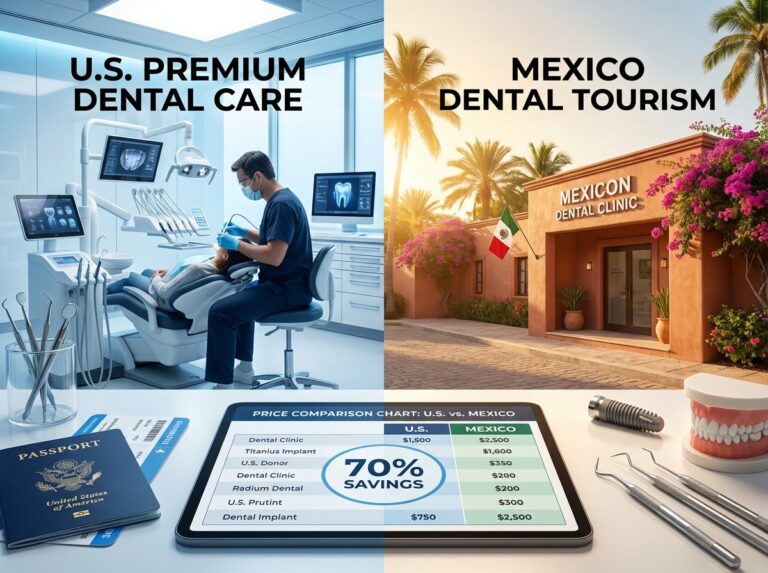
Understanding the financial side of dental care in Los Algodones requires a look at the actual numbers. The price gap between the United States and this border town remains significant as we move through 2025. Most patients find that they can save between 60 and 80 percent on major procedures. These savings hold steady even when you factor in travel costs. The following table provides a realistic look at what you might pay for common services compared to typical costs in a private US practice.
| Dental Service | Los Algodones Price Range | Typical US Cost |
|---|---|---|
| Dental Cleaning | $35 to $180 | $100 to $200 |
| Simple Filling | $50 to $150 | $150 to $300 |
| Composite Filling | $100 to $350 | $200 to $400 |
| Root Canal (Anterior) | $150 to $450 | $700 to $1,100 |
| Root Canal (Molar) | $340 to $1,500 | $1,200 to $2,000 |
| Porcelain or Zirconia Crown | $350 to $1,200 | $1,200 to $2,500 |
| Porcelain Fused to Metal Crown | $230 to $450 | $800 to $1,500 |
| Porcelain Veneer | $450 to $1,000 | $1,000 to $2,500 |
| Single Dental Implant Complete | $700 to $1,600 | $3,000 to $6,000 |
| Implant Supported Overdenture | $4,250 to $13,850 | $15,000 to $35,000 |
| Simple Extraction | $50 to $250 | $150 to $300 |
| Surgical Extraction | $180 to $650 | $300 to $600 |
| Teeth Whitening | $180 to $500 | $300 to $600 |
| Full Mouth Reconstruction | $9,000 to $20,000 | $30,000 to $80,000 |
Material Choices and Price Shifts
The material you choose for a crown or bridge will change your final bill. Porcelain fused to metal is the most affordable option. It is durable but sometimes shows a dark line at the gum. Zirconia is more expensive because it is incredibly strong and looks more like a natural tooth. It is often the best choice for back teeth that do a lot of chewing. E.max is another premium ceramic used for front teeth because of its high translucency. You can find a more detailed Dental Prices List in Los Algodones Mexico [2025] to see how these materials are priced at specific clinics. The skill of the lab technician also plays a role. High end clinics often use master ceramists who charge more for their artistry.
The Impact of Implant Brands and Hidden Fees
Implant pricing depends heavily on the brand of the hardware. Premium brands like Straumann or Nobel Biocare often add a surcharge of $200 to $800 per implant. These companies have decades of research and global support. If you ever need a part replaced in the future, any dentist in the world can find the right tools for these brands. Value brands like Implant Direct or Hiossen are also available. They are reliable and FDA approved but cost much less. Be aware that quoted prices are usually base estimates. The final cost might increase after the dentist sees your actual bone density via a CBCT scan, which often costs between $150 and $300. You might also need bone grafting or a sinus lift that was not visible on your initial X-rays. A complete implant package in Los Algodones usually includes the titanium post, the abutment, and the final crown. Some low quotes only cover the post, so you must ask if the price is for the entire finished tooth.
Sedation and Anesthesia Costs
Local numbing is standard for most procedures and is included in the price. However, if you have dental anxiety, you can request oral sedation or nitrous oxide. For major surgeries, some clinics offer IV sedation with a licensed anesthesiologist on site. This service is not standard in every clinic and typically adds $300 to $1,000 to your bill depending on the duration of the surgery. If you choose IV sedation, you must bring a companion to help you walk back across the border, as you will not be able to drive or navigate the crossing alone while recovering.
Lab Fees and Shipping Logistics
Many clinics in Los Algodones have their own in house labs. This keeps costs down and speeds up the process. Some clinics can even produce a crown on the same day using digital milling machines. Other clinics prefer to work with specialized labs in the United States for complex cosmetic cases. If your work is sent to a US lab, expect to pay more. You will also likely see a shipping fee on your quote. These fees range from $75 to $350 depending on how fast the work needs to travel across the border. Using a US lab can add a week or more to your treatment timeline.
Insurance and Reimbursement
Most Mexican dentists do not bill US insurance companies directly. You will need to pay the clinic in full at the time of service. However, the office can provide you with a detailed invoice and the necessary ADA codes for your claim. You then submit these documents to your insurance provider for reimbursement. Check with your insurance company before you go to see if they cover work done outside the country; many PPO plans will pay back a portion of the cost as “out-of-network” care.
Calculating Your Net Savings
To understand the real value, you have to look at the total out of pocket cost. Consider a common scenario where a patient needs two dental implants with crowns. In the United States, this would typically cost around $8,000. In Los Algodones, the same procedure with mid-range materials would cost about $2,200 for the dental work. You must add travel expenses to this number. A three day trip might include $400 for a flight or gas, $300 for a hotel, and $150 for meals. Your total cost for the trip and the dental work would be roughly $3,050. This results in a net savings of nearly $5,000. For many people, this amount is enough to cover the cost of a second trip for a follow up or even a small vacation. The savings become even more dramatic for full mouth reconstructions or All on 4 procedures where the difference can be $20,000 or more.
How to plan your trip and choose the right clinic
Planning a dental trip to Los Algodones requires more than just booking a flight and showing up at the border. Since it is late December 2025, the town is currently in its peak season with many retirees and winter travelers filling the clinics. Success starts with a rigorous research phase that happens weeks before you leave home. You should begin by verifying the credentials of any dentist you consider. In Mexico, every licensed dentist has a professional license number known as a Cedula Profesional or CED. You can ask for this number and verify it through the Mexican government’s National Registry of Professions. This step ensures the person treating you has the proper legal standing to practice.
Beyond licenses, you need to look at recent patient reviews on independent platforms. While clinic websites show the best cases, third-party sites or social media groups often provide a more balanced view of the long-term results. Request before and after photos of cases that specifically match the work you need. If you are looking for a full mouth reconstruction, seeing a simple filling success story is not enough. Ask for itemized quotes early on. A reputable clinic will provide a breakdown that includes the cost of the implant body, the abutment, the crown, and any necessary imaging or sedation fees. This prevents the common issue where a low starting price for an implant grows significantly once you arrive.
The vetting process should involve a specific checklist to ensure safety and quality.
Sterilization Standards
Ask the clinic about their infection control protocols. They should use an autoclave for instrument sterilization and be willing to show you their biological spore test records or sterilization logs. This is a standard requirement for high-quality care in 2025. The staff should use fresh gloves and sterile, packaged instruments for every patient.
Digital Imaging Availability
Ensure the clinic has on-site digital X-rays and ideally a Cone Beam CT (CBCT) scanner. This technology is vital for accurate implant placement and identifying underlying bone issues that a standard 2D X-ray might miss.
Foreign Patient Coordinator
Most top-tier clinics in Los Algodones employ English-speaking coordinators. These individuals manage your appointments, explain the treatment plan, and help with logistics. Having a clear line of communication in your native language reduces the risk of misunderstandings during complex procedures.
Written Warranty and Emergency Plan
Request a written copy of the clinic’s warranty. Most offer one to five years on crowns and implants, but the terms usually require you to return to the clinic for any repairs. The warranty is usually conditional on maintaining good oral hygiene and attending regular checkups. You should also ask for a written emergency plan that includes a local contact number and advice on what to do if a complication arises after you return to the US.
Before you travel, most clinics offer a remote consultation. To get an accurate estimate, you will need to send specific files. This typically includes a recent panoramic X-ray in PDF or DICOM format and clear intraoral photos. You can take these photos at home by using spoons to retract your cheeks, capturing the front, sides, and the biting surfaces of your teeth. Providing a brief treatment history or a recent quote from a US dentist helps the Mexican team understand your needs. When you receive multiple quotes, compare the brands of materials used. A quote using premium brands like Straumann or Nobel Biocare will naturally be higher than one using economy brands. You can find more details on how these materials affect the bottom line in this Dental Prices List in Los Algodones Mexico [2025].
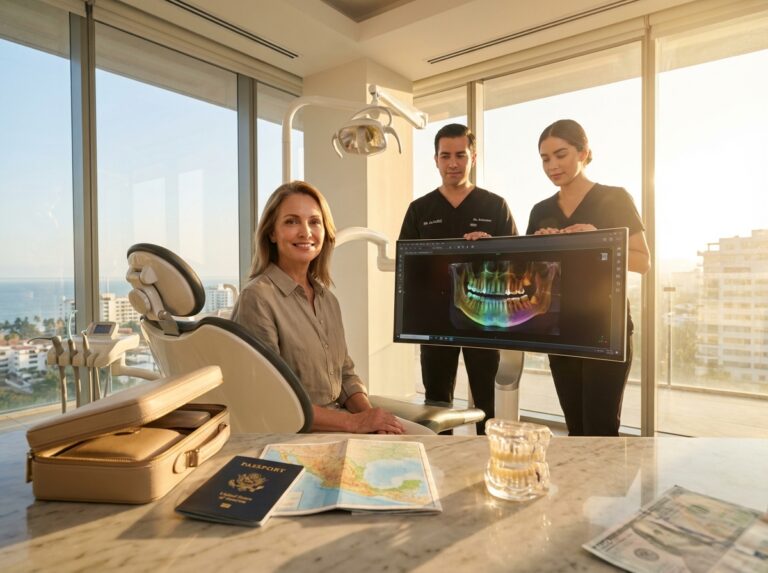
Logistics are the next hurdle. Most patients fly into Yuma International Airport (YUM) which is only about 20 minutes from the border. Other options include San Diego (SAN) or Phoenix (PHX), but these require a two to four-hour drive or a shuttle service. For the border crossing itself, walking across at the Andrade, California entry is almost always faster than driving. You can park your car in one of the secure lots on the US side for a fee of 5 to 20 dollars per day. US citizens must carry a valid passport book or passport card to re-enter the United States. While a visa is not required for short dental visits, having your documents in order is essential for a smooth return.
Timing your trip can save you from long waits. Weekdays are generally less crowded than weekends. If you can travel during the off-season in the late spring or summer, you might find more flexibility in scheduling, though the desert heat is intense during those months. For lodging, you can stay in Yuma for a wider range of midrange hotels or choose one of the small economy inns directly in Los Algodones for convenience.
A typical 3-day itinerary for a single implant usually looks like this.
- Day 1. Arrival, initial consultation, and CBCT scan to confirm bone density.
- Day 2. Implant placement surgery and immediate post-operative check.
- Day 3. Final follow-up, receiving prescriptions for antibiotics or pain relief, and traveling home.
For multi-stage treatments like an All-on-4 or full mouth restoration, plan for 7 to 10 days. This allows time for extractions, bone grafting, and the fabrication of temporary prostheses. Aftercare is handled locally with many pharmacies located within steps of the clinics. These pharmacies are well-stocked with the medications you will need for recovery.
When it comes to paying for your care, USD is the preferred currency. Most clinics accept cash, which sometimes comes with a small discount. Credit cards like Visa and MasterCard are widely accepted, but be aware that some offices add a processing fee of 3 to 5 percent. Tipping is not mandatory but is a kind gesture for dental assistants or coordinators who provide exceptional service. A small gratuity of 5 to 20 dollars is common.
Managing Records and Risks
Before you leave the clinic, ask for a digital copy of all your records, including preoperative and postoperative X-rays and a list of materials used (such as implant brand and size). This information is essential for any future dentist who works on your teeth. Regarding insurance, standard travel insurance often excludes elective dental work. You should look for specialized dental tourism insurance, which can cover the cost of travel and lodging if you need to return for warranty work or medical complications. If you experience pain or a loose crown after returning to the US, you generally have two choices: travel back to Los Algodones to utilize your warranty, or pay a local US dentist out of pocket. Most Mexican clinics will not reimburse you for local US visits, which is why having a local dentist willing to handle maintenance is crucial.
Conclusions and final planning checklist
The price gap between the United States and Los Algodones remains the primary driver for dental travel as we head into 2026. In late 2025, the data shows that patients save between 60 and 80 percent on major procedures. A single titanium implant package in Molar City typically costs between 700 and 1600 dollars. This same work in a private US practice often ranges from 3000 to 6000 dollars. These savings make life-changing restorative work accessible for those without high-end dental insurance.
Choosing the right clinic requires looking past marketing claims. You must verify the Mexican professional license known as the Cedula Profesional. Reputable dentists will provide this number upon request. You should also look for clinics that display current sterilization certificates. Membership in the Mexican Dental Association or the American Dental Association as an international member adds a layer of accountability.
Written guarantees are a vital part of the 2025 dental landscape. Most established clinics offer warranties ranging from one to five years on crowns and implants. You must understand the terms of these agreements. Most warranties require you to return to the same clinic in Mexico for any repairs or remakes. The clinic might cover the cost of the parts and labor. You will still be responsible for your travel expenses.
Logistics require careful timing. You need a valid passport book or card to re-enter the United States. Most patients prefer the Andrade pedestrian crossing because it is faster than waiting in vehicle lines. If you are getting a single crown, a stay of two to three days is usually enough. Major work like an All-on-4 bridge requires a longer commitment. You should plan for seven to ten days for complex cases involving extractions and bone grafting.
Follow-up care is a common point of failure in dental tourism. You need to have a realistic plan for when you return home. Many US dentists are hesitant to work on implants placed abroad. You should find a local dentist who is willing to perform routine cleanings and minor adjustments on your new restorations. If an emergency happens in the US, you will likely pay out of pocket for that visit.
Final Planning Checklist
Verify Professional Credentials
Ask for the dentist’s Mexican license number. Check their standing with the state dental board in Baja California. Confirm how many years they have performed the specific procedure you need.
Request Itemized Quotes
Get a full breakdown of costs in writing. Ensure the quote includes the implant body. Confirm it includes the abutment. Check if the final crown is part of the price. Ask about fees for CBCT scans or sedation. You can compare these figures against a Dental Prices List in Los Algodones Mexico [2025] to ensure the pricing is competitive.
Confirm Material Brands
Ask for the specific brand of implants. Nobel Biocare and Straumann are premium options. Economy brands like Implant Direct are also common. Request the name of the dental lab. Find out if the lab is in-house or located in the US.
Plan Travel Logistics
Check the expiration date on your passport. Book a hotel in Yuma or Andrade. Arrange for a shuttle if your clinic offers one. Plan your arrival for a weekday to avoid the heavy weekend border traffic.
Arrange Emergency Contacts
Get a direct WhatsApp number for your patient coordinator. Ask for the clinic’s after-hours emergency protocol. Identify a local US dentist who can handle minor issues after you return home.
Purchase Specialized Insurance
Look for dental tourism insurance. These policies can cover the cost of returning to Mexico if a complication occurs. Standard travel insurance often excludes elective dental work.
Budget for Contingencies
Set aside an extra 10 to 25 percent of your total budget. This covers unexpected bone grafts. It pays for extra nights in a hotel if the lab work takes longer than expected. It handles the cost of post-operative medications at local pharmacies.
Document Everything
Request copies of your X-rays. Ask for the operative report. Keep the serial numbers for your implant components. These records are essential for any future dentist who treats you.
The goal of traveling to Los Algodones is to restore your smile without draining your savings. You must balance the financial benefits with a commitment to safety. High-quality dental work requires time and precision. Rushing the process to save on hotel costs can lead to poor long-term outcomes.
Success depends on your preparation. When you choose a clinic based on verified credentials rather than just the lowest price, you protect your health. Modern technology like CAD/CAM milling and 3D imaging has made Mexican dentistry more reliable than ever. But the responsibility for vetting the provider still rests with the patient.
Your long-term oral health is the most important factor. Saving thousands of dollars is a significant win. Ensuring that those savings do not come at the expense of clinical standards is the key to a successful trip. Take the time to ask the hard questions. Get every promise in writing. Follow the post-operative instructions exactly as they are given. This disciplined approach ensures that your investment in your teeth lasts for many years.
Sources
- Dental Prices List in Los Algodones Mexico [2025] — The cost of dental bridges in our dental clinic goes from 180 USD to 450 USD, depending on the material you choose for the dental pieces. Get a …
- Mexico Dental Town Prices 2025 | Detailed Algodones Price Lists — MEXICO DENTAL TOWN PRICES COMPARED TO UNITED STATES ; All on 4 Dental Implants (per Arch), From $20,500 USD, From $9,500 USD ; All on 6 Dental Implants (per Arch) …
- Low-Cost Dentist Prices in Los Algodones • 2025 | 50 % Savings — Cost of Cosmetic Dentistry in Los Algodones Mexico ; 3-Unit Dental Bridge. $1,350 USD Per Bridge ; 4-Unit Dental Bridge. $1,800 USD Per Bridge ; 5-Unit Dental …
- 2025 Los Algodones Dentist Price List & Cost Comparison — Los Algodones dentists offer PFM-based three-crown bridges at $690. The partial acrylic dentures cost $190, while the complete denture costs …
- Cost of Dental Work in Los Algodones | Save 70-80% of US Prices — Dentist Prices in Los Algodones … For instance, the cost of dental implants in Los Algodones, Mexico, is around $750, while the same will cost you about $3,000 …
- Pricing Los Algodones, MX – Rumo Dental Group — Whitening, fillings and extractions ; Teeth Whitening, $450, $220 ; Resin composite filling (white), $350, $100 ; Simple extraction, $300, Starts at $80 ; Wisdom …
- Los Algodones Dental Price List (2025) — Laser Cleaning $180 · Zoom Whitening $280 · Teeth Whitening $180 · Cleaning $50 · Simple Extraction $50 · Composite Filling $50 · Wisdom Teeth Extraction $180.
- Dental Price List in Mexico – Sani Dental Group — Titanium Dental Implant (implant only). Sani. $ 890. MXN $17,800. USD. $1,290 ; Standard Implant Crown (including abutment). Sani. $ 720. MXN $14,400. USD.
- Dental Costs in Mexico: Complete 2025 Price Guide and Savings … — A single dental implant, including the implant, abutment, and porcelain crown, typically costs $750 to $1,200 in Mexico compared to $3,000 to …
- Los Algodones Dental Price List- Packages [2026] — Cost of Dental Work in Mexico ; Full Denture. acrylic – upper or lower. $320, $1,800 ; Full Denture. composite – upper or lower. $450, $2,000 …
Legal Disclaimers & Brand Notices
The information provided in this article is for informational purposes only and does not constitute medical advice, diagnosis, or treatment. Always seek the advice of your dentist, physician, or other qualified health provider with any questions you may have regarding a medical condition or procedure. Never disregard professional medical advice or delay in seeking it because of something you have read in this article.
All product names, logos, and brands mentioned in this text are the property of their respective owners. All company, product, and service names used in this article are for identification purposes only. Use of these names, trademarks, and brands does not imply endorsement.