Considering dental care in Tijuana? This 2025 update reviews safety, quality, costs, and logistics for U.S. patients seeking affordable dentistry across the border. The article breaks down how to vet clinics, what certifications and infection controls to require, travel and legal precautions, and real-world planning steps to reduce risk and ensure predictable outcomes.
Why Patients Choose Tijuana for Dental Care
The decision to cross the border for dental care is almost always driven by one powerful factor: cost. In 2025, the financial reality for many Americans is that comprehensive dental work is simply out of reach. With high-deductible insurance plans that barely cover major procedures and a significant portion of the population remaining completely uninsured, the gap between necessary care and affordable options has widened. This is where Tijuana has carved out its niche. The city has become a primary destination not for routine cleanings, but for high-value, complex procedures that can be financially crippling in the United States.
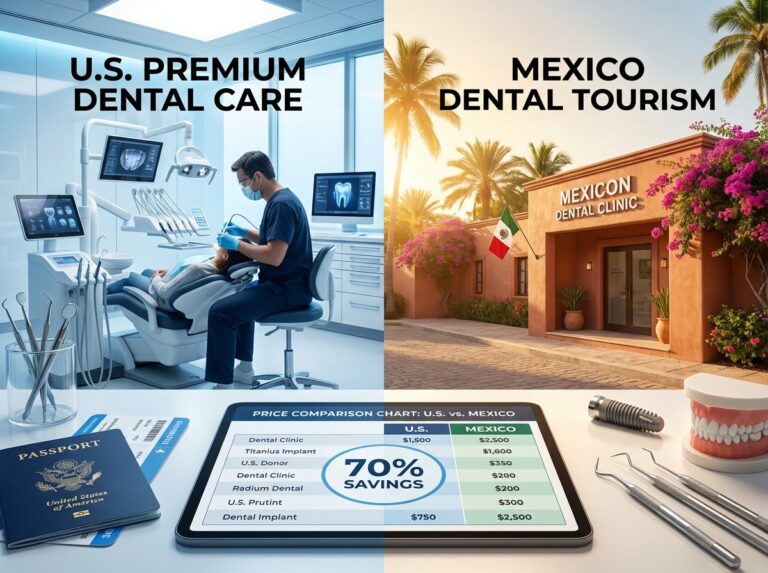
Patients flock to Tijuana for treatments like full-mouth restorations, dental implants, porcelain veneers, and cosmetic smile makeovers. These are the very services that can cost tens of thousands of dollars stateside. Dental travel platforms consistently report savings between 50% and 80% compared to U.S. prices. For example, a single dental implant with a crown that might cost $3,500 or more in the U.S. can often be found for around $1,200 to $1,800 in Tijuana. A high-quality porcelain crown priced at $1,500 in a U.S. clinic might be quoted at $400 to $550 across the border. Similarly, a full set of porcelain veneers that could easily exceed $20,000 in the States might cost under $6,000 in Tijuana. It is crucial to remember that these are generalized figures. Prices vary significantly based on the clinic’s reputation, the materials used, and the complexity of your case. Always obtain a detailed, current quote directly from any clinic you are considering.
The city’s geographic location is a major part of its appeal. For millions in Southern California, a trip to the dentist in Tijuana is easier than a cross-country flight. The San Ysidro and Otay Mesa border crossings are major arteries for dental tourists, with many clinics located just a short drive from the port of entry. For patients traveling from farther away, the Cross Border Xpress (CBX) is a game-changer. This enclosed pedestrian bridge connects a terminal in San Diego directly to the Tijuana International Airport (TIJ), allowing travelers to fly into Tijuana and walk across to the U.S. side without ever dealing with the land border crossing. This convenience transforms Tijuana from a regional option into a national one.
Travel logistics depend entirely on the treatment plan. A simple procedure like a single crown or an extraction can often be done in a same-day trip, especially for those driving from nearby cities. However, more involved work like implants or a full set of veneers requires a multi-day stay. A typical implant journey involves an initial visit of a few days for the surgery, followed by a healing period of three to six months back home, and then a final trip of several days to place the permanent crown. It’s also wise to consider seasonal trends. Clinics often see a surge in appointments during U.S. holidays and summer months, from June to August and again from November through January. If you plan to travel during these peak times, booking your appointments four to eight weeks in advance is highly recommended.
The modern dental market in Tijuana is sophisticated and geared specifically toward American patients. You will find a landscape dominated by private clinics that look and feel much like their U.S. counterparts, complete with modern technology and English-speaking staff. Many of these clinics offer comprehensive packages that bundle dental work with logistical support, including transportation from the border, partner hotel accommodations, and translation services. This structure is designed to make the experience as seamless as possible. The industry also relies heavily on online reviews and third-party facilitators. These facilitators act as brokers, connecting patients with clinics and often handling the travel arrangements.
When comparing costs, it is essential to think in terms of the “total landed cost.” The attractive price of a procedure is only one part of the equation. You must also factor in airfare or gas, accommodation, meals, and potential lost wages. It is also wise to budget for possible follow-up visits or the cost of managing minor complications with a local dentist upon your return.
Let’s look at a hypothetical scenario for a full-arch restoration (All-on-4), a procedure that restores an entire upper or lower set of teeth on four implants.
- In the U.S.
The average cost for this procedure is around $25,000 per arch. - In Tijuana
A clinic might quote the same procedure for $9,500. To calculate the total landed cost, you would add expenses like round-trip flights to San Diego ($400), a five-night hotel stay ($500), ground transportation ($100), and meals ($250). This brings the total to approximately $10,750.
In this illustrative case, the savings would still be over $14,000. These numbers are purely for demonstration and must be verified with current, personalized quotes.
Before you even start looking at clinics, there are a few crucial preparatory steps to take.
- First, consult with your home dentist. Get a formal diagnosis, a proposed treatment plan, and a cost estimate. This gives you a clear baseline for comparison.
- Collect all your relevant dental records. This includes recent X-rays, especially a panoramic X-ray or a CBCT scan if you are considering implants. Most Tijuana clinics will ask for these to provide an accurate preliminary assessment.
- Begin your online research. Look at clinic websites, paying close attention to their before-and-after galleries and the types of procedures they specialize in.
- Finally, reach out to your top two or three choices to request a preliminary virtual consultation. This is your chance to discuss your case, get a feel for their communication style, and receive a detailed treatment plan and quote before making any travel commitments.
Evaluating Safety and Quality of Care
Once you’ve decided the potential savings are worth exploring, the real work begins. Ensuring your safety and the quality of your dental care in Tijuana requires a proactive, detailed vetting process. Think of it as a crucial part of your treatment plan. Cutting corners here can negate any financial benefits. As of 2025, reputable clinics expect and welcome informed questions from potential patients.
Your first step is verifying credentials. Every licensed dentist in Mexico must have a Cédula Profesional, a professional license issued by the government. Ask for a copy or the license number for every dentist who will be treating you, not just the clinic owner. The clinic itself should be registered with COFEPRIS, Mexico’s health regulatory agency, which is similar to the FDA. They should be able to provide proof of this registration. While you might see mentions of international accreditations, understand what they mean. Accreditations like the Joint Commission International (JCI) are typically for large hospitals, not private dental clinics. A clinic might instead belong to international dental associations or have quality seals from private organizations. These can be positive signs, but the Cédula and COFEPRIS registration are the non-negotiable basics.
Next, scrutinize the clinic’s safety protocols. Infection control is paramount. Ask directly about their sterilization process.
- Do they use an autoclave for sterilizing instruments? Can they show you recent autoclave logs that document successful sterilization cycles?
- Are items like needles, gloves, and suction tips single-use and opened in front of you?
- What are their specific protocols for preventing the transmission of bloodborne pathogens like Hepatitis and HIV?
A professional clinic will have clear, documented answers. If you plan on having sedation, anesthesia safety is critical. The staff administering sedation should have advanced training like Advanced Cardiac Life Support (ACLS). The treatment room must have modern monitoring equipment, including a pulse oximeter, a blood pressure cuff, and ideally, capnography to monitor your breathing. Ask about their emergency plan. Which hospital would they transfer you to in a crisis, and what is their protocol for it?
The quality of dental materials directly impacts the longevity of your treatment. Don’t settle for vague answers about “high-quality” materials. Ask for the specific brands of implants, crowns, or veneers they use. Reputable clinics often use globally recognized brands like Straumann or Nobel Biocare for implants. They should provide you with documentation, including lot numbers and any manufacturer warranties. Find out where their crowns and prosthetics are made. Is it an in-house lab, a local Tijuana lab, or are they outsourced? The quality can vary significantly. Finally, ensure their radiology standards are current. They should be using digital X-rays and have panoramic or CBCT scanners for complex cases, and they must be willing to provide you with digital copies of all your images.
Beyond the technical checks, you need to evaluate the clinic’s transparency and professionalism. Online reviews and before-and-after galleries are a starting point, but look for detailed, dated reviews that describe specific procedures. Be wary of galleries that only show perfect “after” shots without corresponding “before” images or any clinical context. Be alert for red flags during your communication. A major one is a refusal to provide a detailed, itemized treatment plan in writing before you commit. Others include pressure to pay for the entire treatment in cash without an official receipt, a lack of a formal informed consent process, or an inability to show you examples of their previous work that are similar to your case. Also, trust your gut. If photos of the clinic look unclean or disorganized, it’s a bad sign. Before booking, confirm their post-operative support system. Who do you contact if you have a problem at 10 PM on a Saturday? Get an emergency contact number.
Protect yourself legally and financially. Your relationship with the clinic should be documented. Insist on a written treatment plan that details each procedure, the cost, and the timeline. You should also receive a written guarantee or warranty for the work, outlining what is covered, for how long, and who pays for travel if a remake is needed. Ask for their refund policy. All payment terms should be clear, and you should always receive an itemized invoice for every payment you make. While resolving cross-border disputes can be complex, having this documentation is your first and most important line of defense.
Finally, plan your follow-up care. Discuss with your U.S. dentist beforehand if they would be willing to handle routine follow-ups or manage minor complications. This isn’t always possible, so have a plan. For complex procedures like implants, consider a staged approach. You might have the surgical placement done in Tijuana and, after the healing period, have the final crown or bridge completed by your dentist at home. This requires careful coordination, and the Tijuana clinic must be willing to provide all necessary records, including implant specifications and surgical notes, to your U.S. provider.
Here is a practical checklist to use before you go.
Pre-Departure Vetting and Travel Checklist
- Documents to Request from Clinic:
- Copy of the dentist’s Cédula Profesional.
- Proof of the clinic’s COFEPRIS registration.
- Written, itemized treatment plan with costs and timeline.
- Written warranty and refund policy.
- Examples of past cases similar to yours.
- Key Questions to Ask:
- What specific brands of materials (e.g., Straumann implants, E.max crowns) will be used?
- Where is your dental lab located (in-house or outsourced)?
- What are the specific terms of the warranty on crowns and other prosthetic work?
- Can I see your sterilization area and autoclave logs?
- What monitoring equipment and emergency protocols are in place for sedation?
- Who is my 24/7 emergency contact after the procedure?
- Will I receive digital copies of all my X-rays and records?
- Minimum Standards to Demand:
- All instruments are either single-use or properly autoclaved.
- A formal informed consent process is completed before any work begins.
- An itemized receipt is provided for all payments.
- Travel Safety Precautions:
- Book accommodations in reputable areas like Zona Rio or Zona Centro, which are close to major clinics.
- Travel during daylight hours and be aware of your surroundings.
- If you are receiving sedation, you must have a companion to escort you back across the border.
- For multi-day stays, consider registering your trip with the U.S. State Department’s Smart Traveler Enrollment Program (STEP).
- Always check the latest U.S. State Department travel advisories for Baja California before your trip.
Frequently Asked Questions
What are the risks of infection or complications and how likely are they?
The risk of infection or complications exists with any surgical procedure, whether it’s performed in the U.S. or Mexico. The likelihood of these issues in Tijuana is low if you choose a high-quality clinic that adheres to strict international sterilization standards. Reputable clinics use autoclaves to sterilize instruments, employ single-use needles and supplies, and follow protocols similar to those recommended by the CDC and ADA.
Reported infection rates for procedures like dental implants are generally in the 1-5% range, which is comparable to rates in the U.S. and depends heavily on the patient’s health and aftercare habits. To minimize your risk, be transparent about your medical history, especially conditions like diabetes or autoimmune disorders. Follow all pre- and post-operative instructions carefully, particularly regarding antibiotics and oral hygiene.
What if I have complications after returning home?
This is a crucial question and highlights the importance of contingency planning. First, contact your Tijuana clinic immediately. Many top clinics offer post-op support via phone, email, or WhatsApp and can guide you on initial steps. They may prescribe antibiotics to a local pharmacy or advise you on managing minor issues like swelling or discomfort.
For more serious complications like a severe infection or a failed implant, you will likely need to see a dentist in the U.S. This is where your contingency fund becomes essential, as this care will be an out-of-pocket expense. Before you travel, it’s a good idea to identify a local U.S. dentist or oral surgeon who is willing to provide follow-up or emergency care. Some clinics in Tijuana have partnerships with U.S. dentists for this purpose, so be sure to ask.
Will my U.S. dentist be able to treat complications?
Most U.S. dentists will treat acute complications like an infection or abscess without hesitation, as their primary duty is to the patient’s health. However, many are reluctant to work on or adjust complex restorative work, like crowns or implants, done by another dentist, especially one in another country. This is due to liability concerns and potential difficulties with unfamiliar implant systems or materials.
Before you go to Tijuana, have an honest conversation with your U.S. dentist. Explain your plans and ask if they would be willing to handle routine follow-up care or manage potential complications. If they are not, you may need to find another local dentist who is open to it or be prepared to travel back to Tijuana for any adjustments covered under your treatment warranty.
Will U.S. dental insurance cover procedures abroad?
In most cases, no. The vast majority of U.S. dental insurance plans, including PPOs and HMOs, do not cover treatment performed outside the United States. Medicare and Medicaid also do not provide coverage for dental work abroad. You should assume you will be paying for your treatment entirely out of pocket.
However, it is always worth calling your insurance provider directly to confirm their policy. Some plans may offer reimbursement for a small portion of the cost if the procedure is considered an emergency or if they have an out-of-network allowance that doesn’t exclude international providers. If they do offer any potential for reimbursement, get the details in writing before you travel and be prepared to submit detailed documentation from the Tijuana clinic.
How do I handle anesthesia and sedation safely?
Safety during sedation is paramount. If you are considering anything beyond local anesthesia (like nitrous oxide or IV sedation), you must verify the clinic’s protocols. Ask if a dedicated, certified anesthesiologist will be administering and monitoring the sedation. This is the gold standard of care. For IV sedation, the clinic should use modern monitoring equipment, including a pulse oximeter, blood pressure cuff, and capnography.
Confirm that the staff is trained in Advanced Cardiac Life Support (ACLS) and that the clinic has emergency equipment, including oxygen and a crash cart. You should also be given clear pre-sedation instructions, such as fasting requirements. If you are undergoing sedation, you must arrange for a companion to accompany you back to your hotel and across the border, as you will not be in a condition to travel alone.
Do I need to bring copies of my medical records or take any pre-travel health precautions?
Yes, absolutely. Bring both digital and printed copies of your relevant dental and medical history. This should include any recent X-rays, especially a panoramic X-ray or a CBCT scan if you have one. Also bring a complete list of your current medications, dosages, and any known allergies. Providing this information helps the Tijuana dentist make a fully informed treatment plan and avoid potential complications.
If you have any significant health conditions, such as heart disease, diabetes, or a bleeding disorder, it is essential to get clearance from your U.S. physician before traveling for elective dental surgery. They may have specific recommendations for managing your condition during treatment. Ensure all your routine vaccinations are up to date and discuss any other travel-related health precautions with your doctor.
What border and travel documents are required for land and air entry to Mexico?
For U.S. citizens, the documentation is straightforward. If you are crossing the border by land (driving or walking), you will need a valid passport book or a passport card to re-enter the United States. While you may not be asked for it entering Mexico, it is required by U.S. law for your return. For air travel into Tijuana International Airport (TIJ), a valid passport book is mandatory.
For stays longer than 72 hours or travel beyond the immediate border zone, you will also need to obtain a Forma Migratoria Múltiple (FMM) tourist permit from Mexican immigration (INM) at the port of entry. Many short dental trips do not require this, but it is best to check the latest requirements on the Mexican consulate’s website before you travel.
Should I use a dental tourism facilitator or book directly?
This depends on your comfort level with research and logistics. A dental tourism facilitator can simplify the process by vetting clinics, scheduling appointments, and arranging transportation and accommodation. This can be a great option for first-time travelers, but be aware that they earn a commission, which may influence their recommendations. Ask any facilitator for a transparent breakdown of their services and fees.
Booking directly with a clinic gives you more control and can sometimes be cheaper. However, it requires you to do all the research and vetting yourself, from verifying credentials to reading reviews and coordinating your own travel. If you choose this route, be thorough in your communication with the clinic to ensure there are no misunderstandings about your treatment plan, costs, or schedule.
How to choose between same-day cross-border trips and overnight stays?
The complexity of your dental work should determine the length of your stay. A same-day trip is feasible for simple, single-visit procedures like a dental cleaning, a filling, or perhaps the initial preparation for a single crown. This works best for patients who live close to the border and can easily manage the travel and border crossing times in one day.
For any surgical or complex procedures, such as extractions, root canals, dental implants, or full-mouth restorations, you must plan for an overnight stay of at least one to three nights. This allows for proper recovery time and a post-operative check-up the following day to ensure everything is healing correctly before you travel home. Rushing your recovery can increase the risk of complications.
When should I avoid traveling to Tijuana for dental work?
While dental tourism in Tijuana is a viable option for many, it is not suitable for everyone. You should avoid it if you have highly complex medical conditions that require close monitoring by a team of specialists, such as uncontrolled diabetes, severe cardiovascular disease, or a compromised immune system. The risks of a post-surgical complication are simply too high.
Additionally, if you are seeking a highly experimental or specialized procedure that is not commonly performed, it is better to seek treatment from a top specialist in the U.S. Finally, if the thought of navigating a foreign healthcare system, dealing with potential language barriers, and planning for cross-border travel causes you significant stress, the potential savings may not be worth the anxiety. Your peace of mind is an important part of a successful health outcome.
Conclusions and Practical Recommendations
After weighing the costs, risks, and potential rewards, we arrive at the central question: is getting dental work in Tijuana a safe and sensible choice for you in 2025? The answer isn’t a simple yes or no. Instead, it’s a conditional yes. Seeking dental treatment across the border can be a perfectly reasonable, safe, and financially sound decision, but only when undertaken with the diligence of a project manager overseeing a critical investment. Your health is, after all, the most important investment you’ll ever make.
The conditions for a successful outcome are clear and non-negotiable. First, the savings must be substantial enough to justify the effort and inherent risks. After you calculate the cost of the procedure, travel, accommodation, meals, and time off work, the discount should still be significant. A 20% savings might not be worth it; a 60-70% savings on a major procedure like a full-arch restoration certainly is. Second, this path is only viable if you partner with a highly qualified, transparent, and verifiable clinic. This means a clinic that eagerly provides documentation, maintains internationally recognized sterilization standards, and communicates clearly in English. Finally, you must have a robust contingency plan. This includes a dedicated fund for potential complications and an understanding with a U.S. dentist for follow-up care, even if it’s just for emergencies. When these conditions are met, Tijuana transforms from a gamble into a calculated strategy for affordable dental care.
To help you navigate this decision with confidence, here is a final checklist. Think of it as your go-no-go sequence. If you can tick every box, you are likely well-prepared. If you encounter roadblocks or red flags at any stage, it’s a clear signal to pause, reconsider, or choose a different path.
- Step 1: Establish Your Baseline in the U.S.
Before you even look at clinics in Mexico, get a comprehensive treatment plan from a trusted U.S. dentist. This should include a full diagnosis, recommended procedures, and an itemized cost estimate. This document is your benchmark for comparing offers and ensuring you’re solving the right dental problems. - Step 2: Vet Your Shortlist of Tijuana Clinics
Do not rely on a flashy website alone. Request and verify these key documents:- The dentist’s Cédula Profesional (professional license).
- The clinic’s current COFEPRIS registration (the sanitary license from Mexico’s health authority).
- Proof of malpractice insurance that covers international patients.
- Credentials for any specialists, like an oral surgeon or anesthesiologist, including their advanced life support certifications (ACLS/BLS).
A reputable clinic will provide these without hesitation. During your virtual consultation, ask pointed questions about their infection control protocols, the specific brands of materials and implants they use (e.g., Straumann, Nobel Biocare), and where their crowns and prosthetics are fabricated.
- Step 3: Get Everything in Writing
A verbal agreement is not enough. Demand a formal, itemized treatment plan that details each procedure, the exact cost per item, the materials to be used, and a projected timeline. Crucially, you must also obtain a written warranty policy that clearly explains what is covered, for how long, and who pays for travel and expenses if rework is needed. A refusal to provide this is a major red flag. - Step 4: Plan Your Logistics and Safety Net
Book your travel and choose accommodation in a safer, tourist-friendly area like Zona Río. Avoid Zona Norte. Arrange for a reputable shuttle service or drive yourself, but only after securing Mexican auto insurance. Most importantly, establish your contingency fund. Set aside at least $1,000 to $3,000, separate from your treatment budget, to cover any unexpected costs for follow-up care or complications once you return to the U.S. Also, look into a travel medical insurance policy that includes medical evacuation, just in case of a serious, non-dental emergency. - Step 5: Arrange Your Post-Op Care Plan
Speak with your U.S. dentist before you leave. Ask if they would be willing to see you for post-operative complications, like an infection or an adjustment. While they won’t warranty another dentist’s work, many are willing to provide emergency care. Confirm with the Tijuana clinic how they handle post-op questions. They should provide a dedicated contact, often via WhatsApp, for you to send photos and ask questions after you’ve returned home.
Ultimately, the decision rests on a careful balance of risk and reward. The financial benefits of seeking dental care in Tijuana are undeniable and can be life-changing for those facing unaffordable treatment in the U.S. However, these savings are earned through meticulous research and preparation. Your safety is not guaranteed by default; it is secured through your own efforts to vet, verify, and plan for every eventuality. Prioritize clinics that value documentation and clear communication. Arm yourself with a written treatment plan, a comprehensive warranty, and a contingency fund for peace of mind. By taking these deliberate steps, you can confidently navigate the world of dental tourism and make a choice that is both safe and smart for your health and your wallet.
Sources
- Is It Worth Going To Tijuana For Dental Work? The Truth for 2025
- Is it safe to travel to Tijuana for Dental Work? – SOFDental
- Should You Get Dental Work in Tijuana? – heva
- Mexico's Top Cities for Dental Tourism in 2025 – Globalcare
- Medical Tourism in Tijuana, Mexico: Prices, Safety & Travel
- Debunking Common Myths About Dental Work in Mexico
- 50 Things You Should Know About Getting Dental Care in Mexico
- Dental Costs in Mexico: Complete 2025 Price Guide and Savings …
- All you need to know about dental care in Mexico 2025
- Dental Implants USA vs. Mexico: The Truth in 2025 – The Town Dentist
Legal Disclaimers & Brand Notices
Medical and Dental Disclaimer: The content provided in this article is for informational and educational purposes only. It is not intended to be a substitute for professional medical or dental advice, diagnosis, or treatment. Always seek the advice of a qualified healthcare provider, such as a licensed U.S. dentist or physician, with any questions you may have regarding a medical condition, procedure, or treatment plan. Never disregard professional medical advice or delay in seeking it because of something you have read in this article. Reliance on any information provided herein is solely at your own risk.
Brand and Trademark Acknowledgement: This article mentions specific dental product brands (e.g., Straumann, Nobel Biocare, E.max) and regulatory bodies (e.g., COFEPRIS, JCI, CDC, ADA). All product names, logos, and brands are the property of their respective owners. The use of these names, trademarks, and brands does not imply endorsement or affiliation.
Regulatory Notice: The information regarding foreign regulatory bodies, certifications (like Cédula Profesional), and travel advisories is subject to change. Readers are strongly advised to verify all credentials, licenses, and travel requirements directly with the relevant governmental agencies and clinics before making any commitments.