Considering dental care abroad? This article compares Mexico and U.S. dental prices for major procedures, explains what drives costs and quality, and provides practical planning advice, safety protocols, and a clinic checklist to help U.S. patients decide if dental travel to Mexico aligns with their treatment needs and budget.
Why Patients Compare Mexico and US Dental Care
The disparity between American dental costs and Mexican prices has reached a peak in late 2025. For many residents of the United States, crossing the border is no longer merely a vacation choice; it has become a health necessity. High domestic prices are the primary driver for this migration. Even with insurance, many U.S. plans impose low annual maximums that barely cover a single crown or root canal. For patients requiring major restorative work, such as implants or full mouth reconstruction, out-of-pocket expenses can rival the price of a luxury vehicle.
The Current Drivers of Dental Tourism
Several economic factors compel Americans to seek care in Mexico. The most significant is the raw cost of procedures in the U.S. Inflation has impacted dental practices heavily, and those operational increases are passed directly to the patient. Furthermore, coverage gaps remain a critical issue; approximately 30 percent of U.S. adults lack dental insurance entirely. Even insured patients often find coverage limited to basic prophylaxis and simple fillings. Accessibility is another factor: while wait times for specialists in major American cities can stretch for months, many Mexican clinics can schedule patients within a week of the initial inquiry. This expediency is vital for those in pain or requiring accelerated treatment timelines.
The volume of cross-border patients is substantial. Estimates for 2025 indicate that over 1.2 million Americans will travel to Mexico specifically for dental care, a 15 percent increase from the previous year. The majority of these travelers seek savings of 50 to 70 percent. You can find more details on these figures in the Cost of Dental Work in Mexico 2025 | Detailed Prices per Treatment guide. This trend persists because the price differential remains consistent even as Mexican clinics modernize their facilities and equipment.
Proximity and Travel Logistics
For patients in the Southwest, the border is easily accessible by car. Tijuana is located just 20 minutes from San Diego; many patients park on the U.S. side and walk across to avoid vehicular border wait times. Los Algodones, known colloquially as “Molar City,” is a small town near Yuma, Arizona, boasting the highest concentration of dentists per square mile globally. The town’s economy is built entirely around American dental tourists. For patients on the East Coast or further north, flying is often the superior option. Direct flights to medical hubs like Cancun or Mexico City are frequent and affordable. As of late 2025, U.S. citizens do not require a visa for stays under 180 days; a valid passport or passport card suffices. While travel advisories for major medical hubs are generally stable, patients should always consult the latest State Department updates before booking.
Common Destination Cities and Local Markets
Distinct Mexican cities cater to specific patient demographics. Understanding these markets aids in selecting the appropriate location.
- Tijuana and Los Algodones
These high-volume border towns are ideal for day trips or expedited procedures. The market is intensely competitive, driving prices down. Options range from budget clinics to high-end centers, often within walking distance of the Port of Entry. - Cancun and Puerto Vallarta
These destinations suit patients wishing to combine surgery with a vacation. Clinics here often resemble luxury spas and specialize in cosmetic dentistry, such as veneers and full mouth restorations. While prices may be slightly higher than in border towns, they remain significantly lower than U.S. averages. - Guadalajara and Mexico City
As the country’s medical hubs, these cities host top specialists and university professors. They are the optimal choice for complex cases requiring hospital settings or advanced oral surgery. The focus here is often on academic-level quality and long-term results rather than the quick turnaround typical of border tourism.
Typical Patient Profiles
Patients benefiting most from cross-border care generally fall into three categories. The first is the uninsured: without negotiated insurance rates, a single implant in the U.S. can cost $5,000, whereas the same procedure in Mexico averages $1,200. The second group requires high-cost restorations; an All-on-4 full arch restoration in the U.S. can reach $45,000 per arch, compared to approximately $12,000 in Mexico. Detailed cost breakdowns are available at Dental Implant Cost in 2025: U.S. vs. Mexico. The third group consists of cosmetic patients; those seeking full sets of porcelain veneers often save enough to cover their entire vacation and treatment while retaining surplus funds.
Regulatory Oversight and Safety
Safety is a paramount concern. In the U.S., the American Dental Association sets guidelines, but state boards handle licensing and oversight. In Mexico, regulation is federal, primarily managed by COFEPRIS (the Mexican equivalent of the FDA). COFEPRIS mandates strict sterilization standards and clinic licensing. Since January 2025, Mexico has required clinics to maintain digital health records to enhance patient tracking. While the ADA does not officially endorse dental tourism, it acknowledges the financial drivers behind it. Patients must verify the cédula profesional (professional license) of their Mexican dentist through the federal registry before commencing treatment.
Major Procedure Price Comparison and Typical Savings
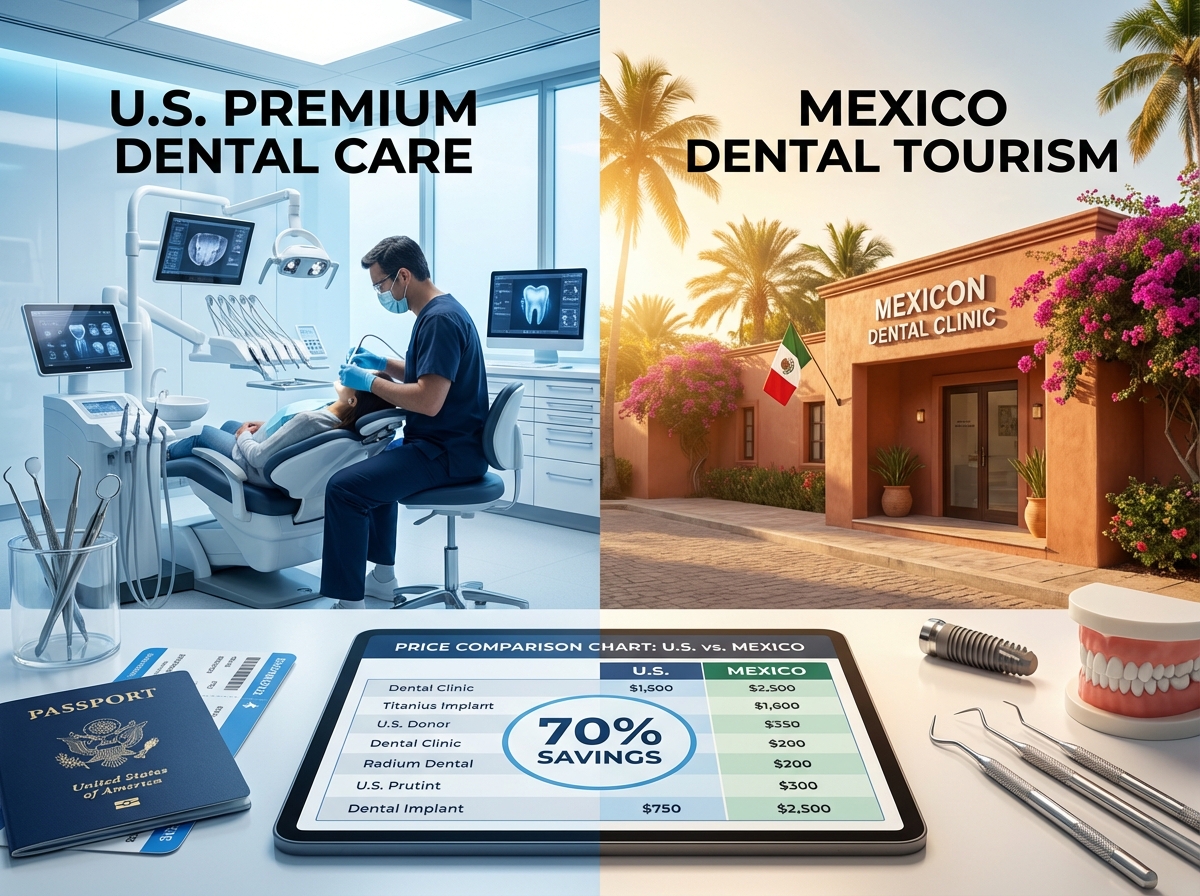
The financial gap between U.S. and Mexican dental care has made cross-border travel a financial necessity for many. In 2025, the average cost for a single dental implant in a major American city ranges from $3,000 to $6,000 (covering surgical placement and the final crown). In contrast, Mexican clinics offer the same procedure for $700 to $2,200, representing a savings of roughly 70 percent. These figures reflect the current 2025 market reality.
Procedure by Procedure Price Breakdown
The following table details price comparisons for common services. Mexican prices are converted to USD at an approximate exchange rate of 20 pesos to 1 dollar.
| Procedure | Typical U.S. Price Range | Typical Mexico Price Range | Approximate Savings |
|---|---|---|---|
| Prophylaxis (Cleaning) | $100 to $200 | $50 to $100 | 50% to 75% |
| Composite Filling | $150 to $300 | $60 to $150 | 60% |
| Root Canal (Molar) | $1,000 to $1,500 | $400 to $450 | 70% |
| Crown (Porcelain-Fused-to-Metal) | $1,000 to $1,500 | $450 to $550 | 65% |
| Crown (All-Ceramic/Zirconia) | $1,200 to $2,500 | $550 to $800 | 70% |
| Porcelain Veneer | $1,000 to $2,500 | $450 to $800 | 65% |
| Single Implant (Placement + Crown) | $3,000 to $6,000 | $1,000 to $2,200 | 70% |
| All-on-4 (Full Arch) | $30,000 to $45,000 | $8,000 to $15,000 | 70% |
| Simple Extraction | $150 to $300 | $60 to $80 | 70% |
| Surgical Extraction | $250 to $400 | $100 to $180 | 60% |
Price Variation by City and Clinic Tier
Rates fluctuate based on location and service level. Los Algodones serves as a budget destination where high volume maintains the lowest prices; a crown there might cost $300. Tijuana and Nuevo Progreso offer mid-range pricing, balancing convenience with modern facilities. Premium destinations like Cancun, Mexico City, and Guadalajara cater to dental tourists seeking a vacation experience or complex specialist care. A crown in a premium Cancun clinic may cost $600—still significantly less than the U.S. average, but reflecting the higher overhead of a luxury setting.
Factors Driving the Price Difference
Structural differences allow Mexican dentists to charge less without necessarily sacrificing quality.
Lower Operational Overhead
Rent and utilities in Mexico are a fraction of U.S. costs. A clinic in Tijuana pays significantly less for square footage than one in San Diego. Labor costs—including salaries for assistants, receptionists, and dentists—are also lower. Crucially, lower pay does not equate to lower skill; many Mexican dentists possess excellent training, with some completing postgraduate studies at prestigious U.S. universities.
Materials and Laboratory Costs
Many Mexican clinics utilize in-house laboratories with CAD/CAM technology to manufacture crowns and veneers on-site. This vertical integration eliminates middlemen and reduces turnaround time. Even when outsourced, Mexican lab technicians have lower overhead. Regarding materials, premium clinics use global brands like Nobel Biocare or Straumann—the same used in the U.S.—which come with international warranties. Budget clinics may use high-quality generic brands to further reduce costs.
Education and Insurance
Mexican dental students often benefit from government-subsidized education, graduating with minimal debt compared to U.S. dentists who may carry hundreds of thousands of dollars in loans. This debt load forces U.S. practitioners to maintain higher profit margins. Additionally, malpractice insurance and administrative legal costs are significantly lower in Mexico, further reducing the financial burden on the practice.
Realistic Net Savings Calculation
To determine true value, patients must account for total travel expenses.
Scenario One: Single Implant in Tijuana for a San Diego Resident
A patient drives from San Diego to Tijuana. The U.S. price is $4,500; the Tijuana price is $1,200. Travel costs include $50 for gas, $220 for two nights in a hotel, and $30 for local transport. The total trip cost is $1,500, resulting in a net savings of $3,000.
Scenario Two: Three Crowns in Guadalajara for a Phoenix Resident
A patient flies from Phoenix to Guadalajara. The U.S. price is $4,500; the Guadalajara price is $1,500. Round-trip airfare is $400, lodging for three nights is $300, and meals/transport add $200. The total trip cost is $2,400, yielding a net savings of $2,100. More details on these rates are available in the Cost of Dental Work in Mexico 2025 guide. These examples demonstrate that savings remain substantial even after including all travel-related expenses.
Quality, Safety and What Price Actually Buys You
While price is the initial attraction, understanding what that money purchases is critical. High-end clinics in Mexico often match or exceed the standards of mid-range U.S. offices by investing in identical global material brands and technology.
Dentist Education and Specialties
Mexican dentists complete a five-year degree followed by a mandatory year of social service. Many practitioners in hubs like Tijuana or Cancun pursue advanced training in the United States, with some specialists graduating from institutions like NYU or USC. It is vital to distinguish between generalists and specialists. Complex procedures like All-on-4 require a prosthodontist and an oral surgeon. Top-tier clinics employ these specialists in-house, ensuring a surgeon places the implant while a restorative expert designs the prosthetics. Credentials can be verified via the cédula profesional, the national professional license number.
Technology and Materials
Premium clinics utilize advanced imaging, such as CBCT scanners, which provide 3D views of bone and nerves essential for implant planning. In the U.S., a CBCT scan can cost $400; in Mexico, it is often $100 or included in the treatment package. Digital impressions and CAD/CAM milling machines allow for precise, rapid creation of crowns. Patients should verify the brands used; reputable clinics utilize leading manufacturers like Nobel Biocare or Straumann. These brands have a global presence, ensuring that a U.S. dentist can source parts for future maintenance if necessary.
Sterilization and Safety Standards
COFEPRIS regulates health clinics in Mexico, setting sterilization and infection control standards similar to the ADA or CDC. Clinics must use autoclaves and perform monthly spore testing to verify equipment efficacy. Patients have the right to inspect sterilization logs and the sterilization room itself. A lack of modern equipment or visible cleanliness is a significant red flag; if a clinic cuts corners on hygiene to lower prices, the risk of infection outweighs any financial benefit.
Warranties and Recourse
Legal recourse in Mexico differs from the U.S.; malpractice lawsuits are rare and the process is different. COFEPRIS handles complaints and can sanction clinics, but a patient’s best protection is a written warranty. Premium clinics often provide five to ten-year warranties on restorations and lifetime guarantees on titanium implant posts. A robust policy should state that the clinic will perform remedial work for free if a restoration fails, though the patient typically bears the travel costs for the return visit. It is also important to plan for follow-up care; some patients find local U.S. dentists for routine maintenance, while others return to Mexico annually.
Verification Checklist for Patients
License Verification
Request the dentist’s cédula profesional and verify it on the Mexican government website.
Clinical Photos
Request at least fifty before-and-after photos of the specific procedure required to assess consistency.
Third-Party Reviews
Consult Google and RealSelf for detailed reviews from U.S. patients, avoiding clinics that only display testimonials on their own site.
Sterilization Proof
Ask to see the sterilization area and inquire about autoclave testing frequency.
Material Documentation
Request the brand and serial number (lot number) for any implants. This documentation is vital for future care and proves the use of genuine products.
Written Treatment Plan & Language
Obtain a signed document in USD listing every fee and warranty term. Ensure the clinic provides informed consent documents in English. If a clinic cannot communicate complex medical terms clearly in English, it is a safety risk.
Planning Your Dental Trip and True Total Cost
Successful dental travel requires methodical planning to avoid unexpected costs. Start by organizing medical records; most clinics require a recent panoramic X-ray and clear digital photos (using a spoon to retract cheeks) for an initial estimate. Obtaining a panoramic X-ray locally in the U.S. is a small upfront investment that facilitates accurate remote quoting.
Step 1. Requesting a Remote Consultation
Send X-rays and photos to selected clinics via secure email or messaging apps. Reputable offices typically provide a preliminary review within 48 hours. Disclose all underlying health conditions, such as diabetes or heart issues, as these influence surgical healing.
Step 2. Getting an Itemized Treatment Plan
Demand a written treatment plan breaking down every expense in U.S. dollars, including anesthesia, imaging (CBCT), and temporary prostheses. Compare these figures against the cost of dental work in Mexico to verify savings.
Step 3. Verifying Credentials and Lab Partners
Verify the cédula profesional and inquire about the dental lab. High-quality clinics use in-house labs or recognized international partners, ensuring materials meet FDA standards. Confirm the use of top-tier brands like Nobel Biocare or Straumann.
Step 4. Estimating the True Total Cost
Calculate the all-in cost: procedure price, flights/gas, lodging, meals, and a buffer for local transport. For a single implant in Tijuana, travel costs are often negligible enough to make the trip profitable even for one tooth.
| Expense Category | Estimated Budget (USD) | Notes |
|---|---|---|
| Round-trip Flight | $250 to $500 | Depends on season/city |
| Hotel per Night | $80 to $160 | Many clinics offer partner rates |
| Daily Food and Transport | $50 to $70 | Uber is widely available and affordable |
| Dental Travel Insurance | $60 to $120 | Covers complications/return trips |
Step 5. Timing and Appointment Sequences
Plan itineraries based on procedure complexity. Implants generally require two trips: 3-4 days for surgery, followed by a return 4-6 months later for the crown. Multiple crowns or veneers can often be completed in a single 5-7 day trip.
| Treatment Type | Initial Trip Duration | Follow-up Trip | Total Timeframe |
|---|---|---|---|
| Single Implant | 3 to 5 days | 3 to 6 months later | Two trips required |
| Multiple Crowns | 5 to 7 days | Not usually required | One trip |
| Full-Arch (All-on-4) | 7 to 10 days | 6 months later | Two trips required |
Step 6. Coordinating Follow-up Care and Insurance
Locate a local U.S. dentist willing to perform routine maintenance on foreign work. Regarding insurance, most U.S. plans do not bill Mexican clinics directly. Patients must pay upfront and submit an itemized receipt (with ADA codes) for potential out-of-network reimbursement. Health Savings Accounts (HSA) or Flexible Spending Accounts (FSA) are often the most effective way to utilize pre-tax dollars for care abroad.
Step 7. Payment Methods
Cash in U.S. dollars is preferred; many clinics offer a 3 to 5 percent discount for cash payments. Credit cards are accepted but often incur a 3 to 5 percent processing fee. Some modern clinics accept Zelle or bank transfers. Always request a formal, itemized receipt regardless of payment method.
Calculating the Break-even Point
Subtract total travel expenses from procedure savings. If a root canal and crown save $1,500 and travel costs $800, the net gain is $700. For major restorations like full mouth implants, savings can exceed $20,000, rendering travel costs a minor fraction of the total benefit.
Final Recommendations and Results
Deciding to cross the border for dental care is a significant financial and health decision. As of late 2025, the price gap remains wide, with most patients saving between 50% and 70% on major restorative work. These savings encompass not just the procedure, but also lower lab fees and professional time. However, success depends on realistic expectations and thorough preparation.
Summary of Cost Savings
The most cost-effective procedures for dental tourism are high-ticket items requiring significant lab work or surgery. Single implants, full-mouth restorations, and multiple crowns offer the highest return on investment. For example, an All-on-4 procedure costing $40,000 per arch in the U.S. can be found for $10,000 to $15,000 in top-tier Mexican clinics. Detailed figures are available in this comparison of dental implant costs in 2025. Even smaller procedures like porcelain crowns show deep discounts, often costing $450 in Mexico versus $1,500 in the U.S., thanks to lower operational overhead as explained in this guide on why dental work is cheaper in Mexico.
Decision Flow: Is Dental Travel Right for You?
Good Candidates for Mexico Dental Travel
You are a strong candidate if you are in good general health and need major restorative work. Patients without dental insurance or those who have exhausted their annual maximum benefit see the most value. Logistics are simplest for those living near the border or near major airport hubs serving Cancun or Mexico City.Who Should Stay Local
Patients with complex medical histories, such as uncontrolled diabetes or high-risk heart conditions, should likely seek care in the U.S. where emergency hospital access is seamless. Additionally, if the required procedure is minor (e.g., a single filling), travel costs will likely negate any savings.
Immediate Action Checklist
- Research at least three clinics with a minimum 4.8-star rating on independent review sites (Google, RealSelf).
- Request a virtual consultation by sending recent X-rays and photos via a secure platform.
- Obtain a written, itemized treatment plan in USD that includes specific brands of implants or crowns.
- Verify the dentist’s cédula profesional and the clinic’s COFEPRIS registration status.
- Calculate total trip cost including airfare, lodging, and a 10% emergency buffer.
Remember that while warranties in Mexico are common (often 5-10 years for implants), they usually require returning to the original clinic for service. Legal recourse is limited compared to the U.S. system. Always verify the latest 2025 price updates and regulation changes before booking, particularly regarding the digital record mandates implemented in January 2025. Stay informed and prioritize your health as much as your budget.
References
- Cost of Dental Work in Mexico 2025 | Detailed Prices per Treatment — Cost of Dental Work in Mexico. Detailed Price Lists per Treatment. Veneers $550 USD; Crowns $550 USD; Snap-On Denture from $6600USD.
- Dental Implant Cost in 2025: U.S. vs. Mexico — In the U.S., this procedure can cost you $30,000.00 to $45,000.00 (per arch), whereas in Mexico, the same procedure is $10,000.00 to $15,000.00 (per arch).
- Mexico Dentists Prices [2026] – Dental Tourism Packages — Mexico dentists prices offer savings up to 70% than in the US. Get transparent and verified pricing from surveyed dentists. Contact MTC team …
- Why is Dental Work Cheaper in Mexico [Complete Guide + Prices] — Dental Work in Mexico is, on average, 50% to 70% cheaper compared to the U.S. and Canada. Depending on the procedure and materials used, …
- Cost of Dental Work in Mexico 2025: Los Algodones Price Guide … — Mexico's lower cost of living lets clinics operate at a fraction of U.S. and Canadian expenses. That means you can save up to 70% on everything …
- Cancun Dentist Prices | 2025 | Treatment + Accomodation — From simple treatments like a dental cleaning that costs 100 USD to composite veneers for 250 USD or porcelain veneers, lumineers, and dental crowns for 450 USD …
- Dental Implants USA vs. Mexico: The Truth in 2025 – The Town Dentist — Cost Comparison: USA vs. Mexico · Single implant: $3,000–$6,000 · All-on-4 full-mouth restoration: $30,000–$45,000 per arch.
- Mexico Dental Prices 2025: How much are Dental Work in Mexico? — Price Comparison per Procedure USA/Mexico ; Cost of Bone Graft, $1,500 USD, $150 USD, 90% ; Cost of Gum Surgery, $600 USD, $120 USD, 80%.
- San Diego Dental Implants vs. Tijuana: Complete Cost and Quality … — Tijuana dental clinics offer single implants ranging from $750 to $1,200, representing a 60-75% reduction compared to San Diego prices. This …
Legal Disclaimers & Brand Notices
The information provided in this article is for informational and educational purposes only and does not constitute professional medical advice, diagnosis, or treatment. Always seek the advice of your dentist, physician, or other qualified health provider with any questions you may have regarding a medical condition or specific procedure. Never disregard professional medical advice or delay in seeking it because of something you have read in this article.
All product names, logos, and brands mentioned in this text, including but not limited to Nobel Biocare and Straumann, are the property of their respective owners. All company, product, and service names used in this article are for identification purposes only. Use of these names, logos, and brands does not imply endorsement.